
Learning With Adults: Dignity, Agency, and the Work of Becoming (Learning Entry 4: Assessing Adult Learning Without Harm)
Apr 23, 2026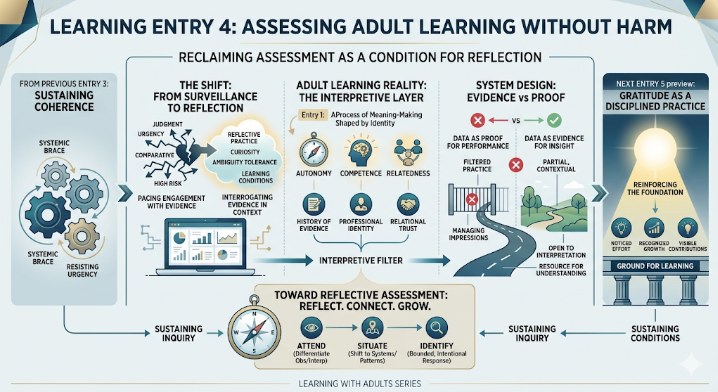
Assessing Adult Learning Without Harm
Reclaiming assessment as a condition for reflection rather than a mechanism of surveillance
By Dr. Amy Pahl and Dr. Morgan Goering
April Series: Learning With Adults: Dignity, Agency, and the Work of Becoming
Estimated read time: ~8 minutes
When Assessment Quietly Reshapes Learning
There are moments in professional learning spaces that appear, at least superficially, to signal progress. A team is gathered around student data, instructional evidence, or implementation metrics. The conversation is active, and the next steps are forming. From a distance, this looks like engagement.
Yet, within the interaction, a subtle shift often occurs. The pace of thinking accelerates—not because understanding is deepening, but because participants are racing toward explanation. Contributions become measured, shaped less by curiosity than by professional safety. What is shared begins to align with anticipated expectations rather than lived complexity. In these moments, assessment ceases to function as a support for learning and begins to operate, however unintentionally, as a signal of judgment.
This shift is rarely the result of a single meeting; it is produced by accumulated experience. Adults carry a history of how evidence has been used in systems—moments where data clarified practice, but also moments where it narrowed identity or reinforced deficit narratives. As a result, assessment is never neutral. It is interpreted through the lens of professional identity and relational trust. The question for the learner is rarely just "What does the data show?" It is, implicitly, "What does this data suggest about my competence and standing in this system?"
Adult Learning Reality: Assessment as a High-Risk Learning Condition
Theories of adult learning explain why assessment so often constrains the very growth it is intended to support. Mezirow (1997) reminds us that transformative learning is not just additive; it is disruptive. When new evidence challenges our prior assumptions, the experience is not purely cognitive—it is also emotional and identity-relevant. Assessment intensifies this because it introduces evidence that is often perceived as public and comparative, accelerating the sense of risk inherent in learning.
Self-Determination Theory (Deci & Ryan, 2000) further clarifies that sustained engagement depends on autonomy, competence, and relatedness. Assessment practices that feel controlling or judgmental diminish these needs. Under these conditions, engagement changes form: individuals participate in ways that protect their identity rather than extend it.
- The Coaching Perspective: Amy’s work in coaching contexts makes this visible in practice. When educators are invited to reflect on evidence of student learning in ambiguous environments, reflection narrows into justification and strategic participation. What is lost is not voice, but vulnerability—the willingness to surface uncertainty, reconsider assumptions, or name what is not yet working. Without that vulnerability, learning remains at the level of adjustment rather than transformation.
- The Safety Perspective: Edmondson (2019) demonstrates that individuals are more likely to engage in learning behaviors—questioning, admitting uncertainty, experimenting—when they believe they can do so without negative interpersonal or professional consequences. Even when leaders intend for data to be reflective, the absence of clear boundaries allows the threat to remain in the room, causing adults to engage in protective sense-making rather than inquiry.
Leadership & Coaching Practice: Repositioning Assessment as Reflective Practice
If assessment is to support learning, leaders must move it from a mechanism of evaluation to a condition for reflection. This requires a disciplined change in how we structure and pace engagement with evidence. Schön’s work on reflective practice is instructive here, particularly his distinction between reflection-in-action and reflection-on-action (Schön, 1983). Learning emerges when we have the opportunity to interrogate evidence in relation to context and decision-making, requiring more than simply exposure to the evidence.
In many systems, however, assessment conversations collapse this reflective space. Evidence is presented, interpreted rapidly and translated into action steps with an efficiency that appears productive but bypasses meaning-making. Morgan’s work across system-level implementation highlights how the pressure for visible responsiveness causes leaders to truncate reflection. Leaders feel compelled to demonstrate action, and in doing so, inadvertently truncate the reflective processes that would make that action more precise and sustainable.
A more rigorous approach requires leaders to hold a different sequence. Observation must precede interpretation, and interpretation must be grounded in shared inquiry rather than individual explanation. This shift demands a unique kind of leadership discipline: the ability to resist the reflexive impulse toward quick resolution and instead cultivate a deliberate tolerance for ambiguity. By holding this space long enough for authentic patterns to emerge, a leader can begin to attend to the critical relational dynamics of the conversation—observing who speaks, noting who hesitates, and tracking how contributions are actually taken up by the group. These observations are far from peripheral concerns; they are the primary indicators of whether the conditions for learning remain intact or if the environment has shifted toward self-protection.
System & Design Lens: Evidence for Insight vs Proof of Performance
At the system level, the challenge is how assessment is positioned. Haertel (2013) warns against conflating evidence with proof. In educational systems, this distinction is frequently blurred. Data intended to inform practice often becomes a proxy for performance evaluation. The consequence is not merely conceptual; it reshapes behavior.
When assessment is experienced as proof, individuals orient toward managing impressions. They filter their practice, giving the system a sanitized version of reality. Explanations are prepared, responses are aligned with perceived expectations, and disclosure of uncertainty is limited. This undermines the very purpose of assessment, which is to surface information that can guide improvement. However, when assessment is positioned as evidence—partial, contextual, and open to interpretation—space is created for a different type of engagement. Assessment data then becomes a resource for understanding rather than a verdict to be defended against.
This distinction is particularly important in professional learning environments, where the goal is not to certify competence but to support its development. When systems rely on assessment practices that mirror evaluative structures, they inadvertently import the constraints of accountability into spaces intended for growth. The result is a persistent tension: learning is expected, but the conditions for learning are compromised.
Toward Reflective Assessment Practice
What matters is not the framework itself, but the consistency with which it is used.
Reframing assessment doesn't require new tools; it requires a more disciplined use of the structures aligned to adult learning. The Reflect. Connect. Grow. Adult Learning Design Framework, introduced in previous entries, acts as a scaffold to ensure assessment supports rather than constrains learning:
- Reflect: Attend to what is present in the evidence without collapsing into explanation. Differentiate between observation and interpretation.
- Connect: Situate evidence within broader patterns—across classrooms and time—shifting attention from individuals to systems.
- Grow: Identify a bounded, intentional response, resisting the impulse to generate multiple actions in favor of a few coherent shifts.
When leaders consistently engage the framework first—using it to interpret their own observations and decisions—they model a way of thinking that can then be extended across the system. When teams encounter the same structure in different contexts, it reduces cognitive load and increases coherence. Assessment becomes less about producing answers and more about sustaining inquiry.
Reflect. Connect. Grow.
- Reflect: How is assessment currently experienced in our system? What explicit or implicit signals are shaping that experience?
- Connect: What patterns do we observe in how individuals and teams engage with evidence? How might our system conditions be contributing to those patterns?
- Grow: What is one shift in how we structure assessment conversations that would strengthen their capacity to support authentic learning?
Looking Forward
Throughout this series, our argument has remained consistent: adult learning is not limited by capacity alone, but by the conditions under which it occurs. When identity is protected, and agency is preserved, adults engage deeply. Assessment sits at the center of these conditions. When used as judgment, it constrains; when used as reflection, it transforms. Coherent systems are at the foundation of such transformation.
Our final entry will turn to Gratitude—not as a peripheral gesture, but as a disciplined leadership practice that reinforces and sustains the relational foundation of learning. In systems where effort is noticed, growth is recognized, and contributions are made visible, the ground is prepared for the structures we have built to truly take hold.
References
American Educational Research Association, American Psychological Association, & National Council on Measurement in Education. (2014). Standards for educational and psychological testing.
Deci, E. L., & Ryan, R. M. (2000). The “what” and “why” of goal pursuits: Human needs and the self-determination of behavior. Psychological Inquiry, 11(4), 227–268.
Edmondson, A. C. (2019). The fearless organization: Creating psychological safety in the workplace for learning, innovation, and growth. Wiley.
Haertel, E. H. (2013). Reliability and validity of inferences about teachers based on student test scores. Educational Testing Service.
Mezirow, J. (1997). Transformative learning: Theory to practice. New Directions for Adult and Continuing Education, 74, 5–12.
Schön, D. A. (1983). The reflective practitioner: How professionals think in action. Basic Books.
