
July Series 2026: Connection First (Entry 4:Capacity Is Built, Not Assumed)
Jul 23, 2026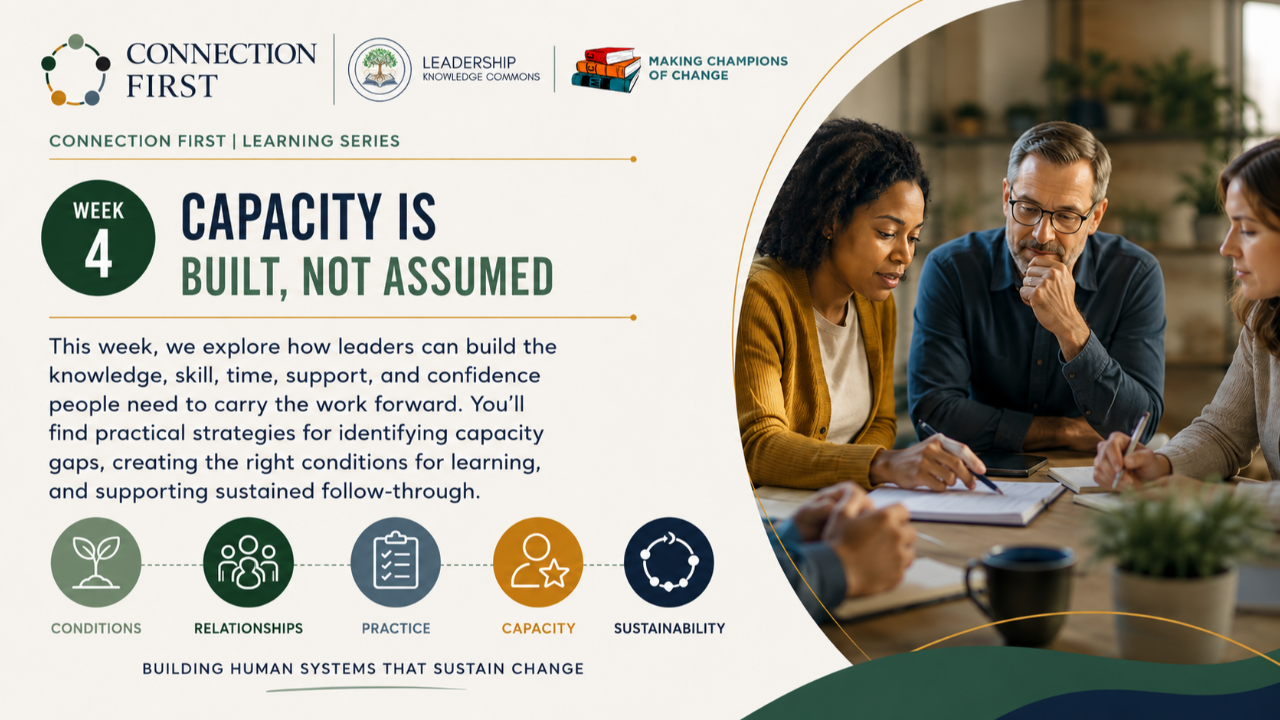
Capacity Is Built, Not Assumed
Knowledge, Skill, Time, Support, Confidence, and Conditions for Follow-Through
Connection First Series — Week 4 of 5 By: Janine Gacke
Estimated read time: ~7 minutes
Practice makes purpose visible, but no one keeps a practice visible on willingness alone. People need the capacity to carry it when the work gets hard — and that is where implementation most often quietly stalls.
There is a point in every cycle when leaders begin to wonder whether the work is actually taking hold. The expectation has been named, the purpose clarified, the practice modeled; maybe there is even a tool or a shared routine people agreed to use. And then the year starts moving. A schedule changes, a student need becomes urgent, a team loses planning time, a new priority arrives. A routine that felt clear in August feels harder in October. Some people keep going because they already have the skill or the confidence. Others begin to drift — not because they do not care, but because the system has asked them to sustain something they were not yet equipped to carry.
This is where the Capacity domain matters. Capacity is often assumed, because people are capable: educators are skilled, leaders are experienced, teams are committed. But capability in general is not the same as capacity for a specific practice, in a specific context, under real conditions, over time. Connection First asks leaders to pause before reading uneven follow-through as resistance or low commitment. Sometimes accountability does need strengthening. But first the question is whether the knowledge, skill, time, support, and confidence people need have actually been built. Capacity is not a personality trait. Capacity is built.
Willing Is Not Ready
One of the easiest mistakes a leader can make is assuming willingness means readiness. A team can agree with a priority and still not know how to enact it. A teacher can believe in a practice and still need modeling before using it with confidence. A principal can understand a district expectation and still need time to translate it into building-level routines. People often say yes before they fully understand what the work will require — because they believe in the purpose, because the leader is asking, or because the meeting is moving too fast to name uncertainty.
Then implementation begins, and the gap appears. It is not always a gap in commitment, it is often a gap in capacity. Implementation research shows that practices become usable when they are taught, supported, coached, and adjusted inside real systems, not simply selected and announced (Fixsen et al., 2005), and professional learning research reinforces that training alone rarely changes practice at scale — people need to see a practice, try it, receive feedback, and refine it over time (Joyce & Showers, 2002).
Capacity is larger than skill. Skill matters — people need to know how to use a practice, facilitate a routine, or interpret data — but it is only one part. Knowledge comes first: do people understand what the work is, and why it matters? Time is the next question — is there protected space to learn, rehearse, and reflect? Support shows up as coaching, examples, and feedback when the work gets hard. Confidence is what lets people believe they can improve rather than feel exposed by what they don't yet know. And conditions hold all of it together, because in a system that is unclear, unsafe, or overloaded, even skilled people struggle to sustain strong practice.
Two of these get overlooked most often: time and confidence. Time communicates priority — when people are asked to improve without protected time to learn, implementation quietly runs on personal sacrifice, which no system can sustain. Confidence is what carries people once the newness wears off; they keep using a practice when they can feel themselves getting more skilled. Bandura's work on self-efficacy shows that belief in one's ability to act shapes whether people persist, especially when the work is hard (Bandura, 1997) — so what people need is to experience progress, not just pressure.
Leadership Practice in the Moment
Because capacity is not one thing, the leadership move is to read the gap before choosing a response. The right move depends on what is actually missing:
- When people do not understand the practice, the move is clarity.
- When they understand it but cannot yet do it, it is modeling and rehearsal.
- When they can do it but aren't doing it consistently, it may be feedback, coaching, or less friction.
- When they're doing it but losing momentum, it may be time, encouragement, or evidence of impact.
- When they're avoiding it because it feels risky, it may be psychological safety and repair.
The important thing is not to treat every gap the same way. A reminder won't build skill, and no checklist creates confidence; a monitoring tool can't fix overload, and a training session won't repair trust. The work of capacity-building leadership is reading the gap before choosing the response.
Most of this happens in small, designed structures rather than large events. A principal who notices staff applying a new routine differently does not send another reminder; she uses ten minutes of a staff meeting to name the purpose, model two examples, and have staff rehearse the language with a partner — then revisits the next week what felt natural, what felt awkward, and where students still need clearer teaching. A district leader who watches teams jump straight to solutions models the first five minutes of a data protocol in a principals' meeting, has leaders practice staying in noticing before interpretation, and sends that same structure back to buildings. These moves are small, but they build capacity because they reduce guessing. They turn the work into something people can see, try, and improve.
System & Structure Lens
When capacity is thin, leaders can misread what they see. A teacher who does not use a routine consistently may be read as resistant, when the routine was never made simple enough to use across a full instructional day. A team that does not follow a protocol may be read as avoidant, when they have not had enough practice facilitating it. When the first response is only pressure, the system misses the capacity gap underneath the behavior. Those gaps — delay, inconsistency, overdependence on one person, quiet avoidance, repeated requests for clarification — are not just frustrations. They are data. So instead of asking only, "Why isn't this happening?" leaders can ask, "What would make this easier to do well?" That question changes the move.
A system that builds capacity does not rely on heroic effort, and it does not depend on one coach, one principal, or one informal leader to keep a practice alive. It builds capacity into routines: the practice shows up in professional learning and in coaching, in team agendas and reflection tools, in expectations and in the time actually allocated to learn them. The system keeps asking what people need next to carry the work well — which guards against two mistakes: assuming capacity already exists because people are professionals, and assuming capacity is built once and then complete. Capacity is built over time, strengthened through repetition, feedback, and reflection, and revisited as people, students, and priorities change. A capacity-building system does not ask people to carry more without also asking what must be taught, protected, simplified, coached, or removed.
Reflect. Connect. Grow.
Reflect. Where might you be assuming adults have the knowledge, skill, time, support, or confidence to carry work that has not yet been fully built?
Connect. Where do capacity gaps show up across classrooms, teams, buildings, or roles — and what might those patterns reveal about the system?
Grow. Where is capacity the thinnest right now? What is one move you could make to build capacity where it is thin that would help people carry the work with more clarity, confidence or support?
Reflect. Connect. Grow.
Expanded Prompts for Learning Entry 4: Capacity Is Built, Not Assumed
Reflect.
Where might you be assuming adults have the knowledge, skill, time, support, or confidence to carry work that has not yet been fully built?
Additional prompts:
- Where are you noticing uneven implementation that may actually be a capacity gap rather than a commitment gap?
- What are people being asked to do that may not have been clearly taught, modeled, practiced, or supported?
- Where might adults understand the purpose of the work but still lack the skill, time, tools, or confidence to carry it well?
- Where are repeated reminders being used when the system may actually need modeling, coaching, feedback, or protected practice time?
- What signals suggest people are willing, but not yet fully ready?
- Where might silence, delay, inconsistency, or over-reliance on one person be telling you that capacity is thin?
Connect.
Where do capacity gaps show up across classrooms, teams, buildings, or roles — and what might those patterns reveal about the system?
Additional prompts:
- Where are capacity gaps showing up as patterns rather than isolated concerns?
- Are the same questions, misunderstandings, or implementation struggles appearing across multiple teams or roles?
- Where does the work look strong in one place but fragile or inconsistent in another?
- What does variation across classrooms, teams, or buildings tell you about what the system has or has not built yet?
- Where are people compensating for unclear systems through personal effort, informal support, or workarounds?
- Which gaps seem connected to knowledge? Which seem connected to skill? Which seem connected to time, support, confidence, or conditions?
- Where is the system depending on individual strength instead of shared capacity?
Grow.
What is one capacity-building move you could make this month so people can carry the work with more clarity, confidence, and support?
Additional prompts:
- What leadership response would best match the gap you are seeing: clarity, modeling, rehearsal, coaching, feedback, time, tools, or removal of barriers?
- Where could you replace a reminder with a more supportive capacity-building move?
- What is one practice that could be made smaller, clearer, and easier to use well?
- What could be modeled or practiced in an upcoming meeting, professional learning space, coaching cycle, or team routine?
- What feedback loop would help people know whether they are using the practice as intended?
- What support would help people experience early success and build confidence?
- What is one system move that would make the work less dependent on a few capable people and more supported across the team?
Optional Closing Prompt for Teams
Before naming next steps, ask:
What capacity gap are we seeing, and what leadership response would actually build the capacity needed to close it?
Then follow with:
What is the smallest concrete move we can make this month to help people carry the work with more clarity, confidence, and support?
Looking Forward
Capacity helps people carry the work, but capacity alone does not guarantee that change will last. Next week, we move into Sustainability: how leaders protect what matters, reduce drift, and build systems that endure beyond a single person, initiative, or moment of urgency.
Conditions create the environment. Relationships hold the complexity of implementation. Practice makes purpose visible. Capacity helps people keep going. Sustainability helps the system last.
Sustainable change begins beneath the strategy.
References
Bandura, A. (1997). Self-efficacy: The exercise of control. W. H. Freeman.
Fixsen, D. L., Naoom, S. F., Blase, K. A., Friedman, R. M., & Wallace, F. (2005). Implementation research: A synthesis of the literature. University of South Florida, Louis de la Parte Florida Mental Health Institute, The National Implementation Research Network.
Joyce, B., & Showers, B. (2002). Student achievement through staff development (3rd ed.). ASCD.
