
Learning With Adults: Dignity, Agency, and the Work of Becoming (Learning Entry 2: Coaching, Not Correcting)
Apr 08, 2026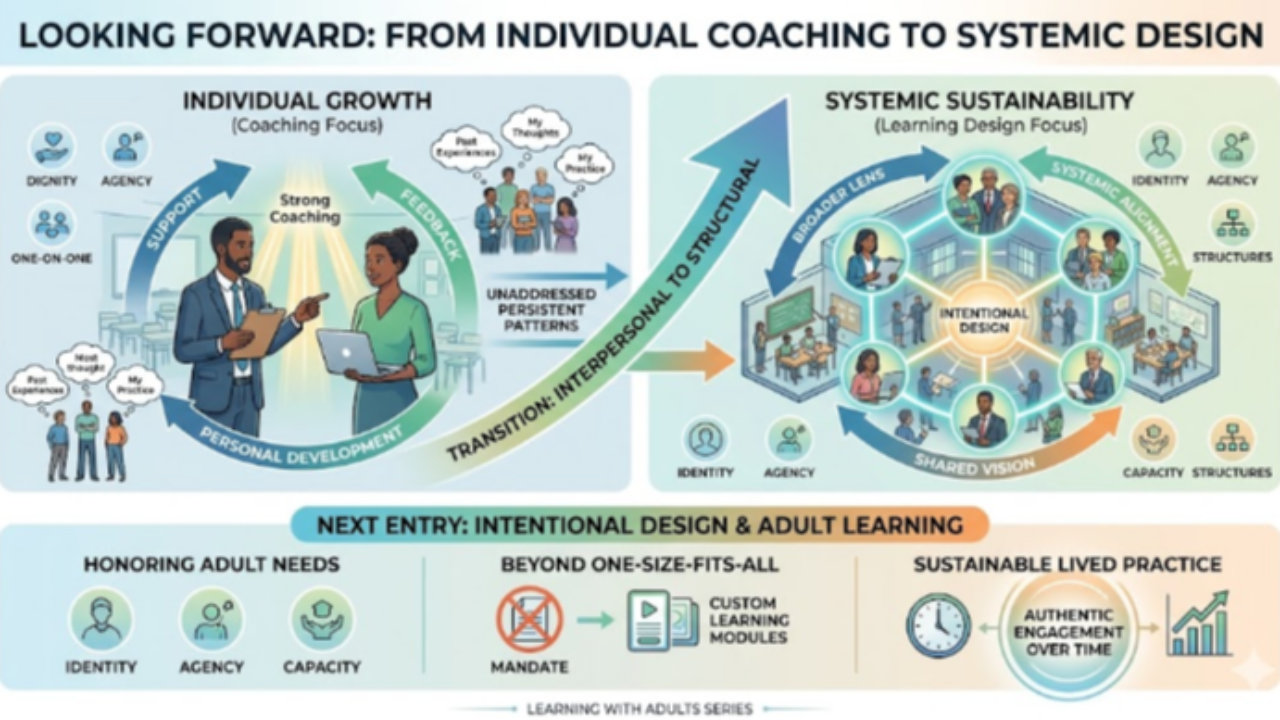
Coaching, Not Correcting: The Power of Adult Learning Models
By Dr. Amy Pahl and Dr. Morgan Goering
April Series: Learning With Adults: Dignity, Agency, and the Work of Becoming
Estimated read time: ~8.5 minutes
When Support Feels Like Judgment
When coaching is experienced as evaluation, adults lean into protective compliance. When it is experienced as a partnership, learning becomes possible.
There is a moment many educators and leaders recognize, even if it is rarely named: a conversation framed as support, intended for growth, where the goal is seemingly clear. Yet, despite these positive intentions, something in the interaction shifts. Responses become measured, and reflection narrows. The conversation drifts toward the surface, even when both individuals sense there is more to explore. What was designed as a space for learning begins to feel like a space for judgment. Even if nothing explicitly evaluative is said and no formal judgment is offered, the experience carries a heavy, unspoken weight.
This tension is one of the most persistent challenges in leadership. Support and evaluation often sit much closer together than our systems intend. Even when leaders approach these moments with genuine care, adults are not just interpreting the words spoken; they are assessing what those words mean for how they are seen, valued, and understood.
In these moments, learning does not stop—it simply changes form. It becomes careful, strategic, and defensive. This is the protective sense-making we explored in our first entry: when an experience feels like judgment, the brain instinctively prioritizes safety over growth. To understand why this happens, we must return to our core principle: adult learning is never just about acquiring a skill. It is an act of meaning-making and identity—and coaching sits directly at the heart of that work.
Adult Learning Reality: Coaching Is Never Neutral
Coaching transcends a mere technical exchange precisely because adults experience learning through the lens of identity. Coaching is a deeply relational experience shaped by power, history, and perception. Educators do not enter these conversations as blank slates; they bring a complex history of feedback—some affirming, some evaluative, and some diminishing. They carry deeply held beliefs about what it means to be competent and how that competence is judged within their specific system.
This history acts as a precursor, meaning coaching is always interpreted before it is received. This creates a gap between a leader's intent and a learner's impact:
- A question intended to prompt reflection may be experienced as a critique.
- Silence intended to create space may be experienced as an expectation.
- Feedback intended to support growth may be filtered through past evaluation.
This disconnect is not a flaw in the individual; it is a fundamental function of how adults make meaning. Research in self-determination theory reinforces that adults engage in growth-oriented behavior when they experience autonomy, competence, and relatedness (Deci & Ryan, 2000). When psychological safety or autonomy is compromised, engagement naturally becomes guarded. Furthermore, reflective practice requires the mental breathing room to test ideas and reconsider assumptions (Schön, 1983). When that space is constrained by the pressure of performance, reflection quickly declines into compliance.
This explains the frustrating pattern many leaders encounter: conversations happen, feedback is shared, and next steps are identified and clearly outlined—and yet, practice does not meaningfully shift. The issue is rarely the absence of coaching; it is how that coaching is being experienced.
Leadership & Coaching Practice: From Correction to Partnership
If coaching is to support adult learning truly, it must move beyond correction and toward the discipline of partnership. This shift is not about adopting new protocols; it is about a fundamental shift in stance.
A stance of correction assumes the leader holds the "right" answer, and the learner's role is simply to align. Even when delivered with care, this approach centers compliance, positioning the learner as a problem to be fixed. Partnership, by contrast, assumes the adult brings indispensable experience and context to the work. Here, the coach’s role is not to replace that expertise, but to engage with it—surfacing assumptions and supporting the reflection that leads to genuine growth.
In practice, this shift changes the very heart and structure of a conversation:
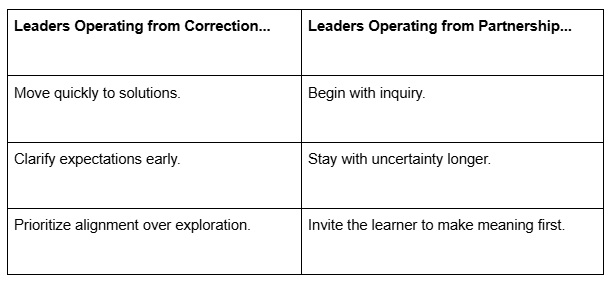
This shift is about sequencing, not avoiding feedback or lowering expectations. In adult learning, meaning-making must come before adjustment.
Transitioning from the classroom to coaching requires a unique kind of discipline. While a clear set of expectations and explicit direction often support student learning, Amy noticed that applying those same moves with adults can unintentionally strip away the reflection and agency necessary for ownership. Effective coaching requires resisting the "quick answer"—even when the urgency for a solution feels high—and instead utilizing responsive questioning that invites adults to reflect on their own practice. Though staying in this discomfort is challenging for both the coach and the learner, it fosters the trust and space required for truly transformative meaning-making to occur.
Often, this move toward partnership requires us to "uncomplicate" our professional models to make room for the person standing in front of us. In one alternative setting, a prescribed coaching model—designed for a more traditional environment—felt increasingly out of sync with the reality the educators experienced. In that context, following the manual was actually creating more distance than growth.
To honor the adults in that space, the process had to be stripped down to its most essential intent. Moving away from the formal model and centering the educator’s current reality instead, returned agency to the educator. Focusing on a few simple questions simplified the process while honoring the intent of coaching.
- What is currently happening in your practice? (Reflecting)
- Considering that reality, what is the one thing you want to work on? (Goal Definition)
- How do you want to partner to pursue that goal? (Partnership)
By simplifying the structure, rigor was maintained, and relevance increased. When the educator felt they were the primary driver of the process—rather than a participant in a model—their protective sense-making dropped away. This is the heart of partnership: trust emerges when the coach values the educator’s expertise and current reality more than the tool.
While Amy’s transition underscores the internal discipline required to honor the person, Morgan’s work across diverse systems reveals the broader impact of those choices. We often assume that systemic coherence is a product of consistent messaging or shared protocols—having everyone say the same thing. However, true coherence is actually found in the consistency of the experience.
When a teacher experiences coaching as a supportive partnership in one building but encounters it as a veiled evaluation in another, they don't just "reset" with each new conversation. Instead, they adapt to the inconsistency by becoming guarded across the board. In a system where support feels unpredictable, trust becomes conditional, and the window for genuine learning narrows.
This reinforces a critical throughline: Partnership is not just an interpersonal move; it is a foundational system condition. It isn't enough for a few gifted coaches to hold the space for reflection; the system itself must be designed so that every adult—regardless of their role or location—can trust that the nature of engagement will remain the same.
System & Design Lens: When Coaching Lives Too Close to Evaluation
At the system level, the proximity of coaching to evaluation remains one of the most significant barriers to growth. Even when formally separated, observations, feedback, and accountability structures often intersect in ways that are difficult to disentangle. This creates a persistent, unspoken ambiguity for the learner: Is this conversation for my growth—or for my assessment?
When this question remains unresolved, adults respond with predictable, self-protective behaviors. They share only what feels safe, minimize their uncertainty, and engage in ways that shield their professional identity. Over time, this shifts the entire culture of learning. Coaching becomes a hurdle to navigate rather than a resource to engage, and feedback becomes a data point to manage rather than a catalyst to explore.
From a design perspective, this is not a failure of individual skill; it is a failure of system clarity. To build a truly transformative coaching culture, leaders must critically examine the design of their systems:
- Positioning: How is coaching formally and informally situated relative to evaluation?
- Framing: How is feedback framed—as a tool for compliance or a vehicle for insight?
- Consistency: How predictably is coaching experienced across different buildings and roles?
Psychological safety research reinforces that individuals only take interpersonal risks when they trust that those risks won't result in negative consequences (Edmondson, 2019). Without that foundational trust, even the most robust coaching models will struggle to produce meaningful change. The goal is not to remove accountability, but to create coherence between support and responsibility. When adults can clearly distinguish coaching as a protected space for reflection, they finally bring the level of honesty that deep learning requires.
Reflect. Connect. Grow. in Coaching Conversations
If coaching is truly a space for meaning-making, it requires a structure that supports reflection without constraining it. The Reflect. Connect. Grow. Adult Learning Design Framework provides a practical anchor for these conversations, ensuring they remain grounded in adult learning principles rather than slipping back into a directive or evaluative mode.
Rather than moving directly to feedback or immediate next steps, this framework invites a purposeful progression:
Reflect (Sense-Making & Identity)
- What felt most successful in your practice?
- Where did you feel uncertain or stretched?
- What were you thinking or noticing in the moment?
The Goal: To honor the learner’s experience and surface the "internal monologue" that drives their actions.
Connect (Patterns & Systems)
- Where have you seen this show up before?
- How does this connect to what your team is experiencing?
- What patterns are emerging across students or settings?
The Goal: To move from isolated incidents to systemic awareness, helping the learner see their work as part of a larger context.
Grow (Intentional Direction)
- What is one small shift you might try next?
- What support would make this easier?
- What would success look like over time?
The Goal: To identify manageable, high-leverage actions that the learner owns and feels capable of implementing.
This structure does not eliminate the need for coach feedback; instead, it ensures that feedback is sequenced correctly. By grounding suggestions in the learner’s own meaning-making process, you increase both the ownership of the next steps and the sustainability of the change.
Reflect. Connect. Grow.
This can be a good time to take a moment to use the framework as a mirror for your own leadership and the coaching culture you are building.
Reflect (Sense-Making & Identity): Think back to your own history with feedback. When has a coaching conversation felt most supportive, and when has it felt purely evaluative? What specific moves made the difference in whether you felt heard or judged?
Connect (Systems Awareness & Patterns): Look across your organization. How is coaching currently experienced by your teams? Where do you see the most significant variation in how "safe" or "supportive" it feels, and what systemic patterns might be causing that inconsistency?
Grow (Intentional Direction): Identity is the lens for all learning. Based on what you've noticed, what is one small, intentional shift you could make in your next coaching conversation to move the needle from correction toward partnership?
Looking Forward
While strong coaching creates the necessary conditions for individual growth, sustaining that learning across an entire system requires a broader lens. Even the most effective coaching cannot fully address the persistent patterns—across classrooms, teams, and roles—that are shaped by the system itself.
In our next entry, we shift from the interpersonal to the structural. We will explore how professional learning can be intentionally designed to honor adult identity, agency, and capacity. We will examine how systems can move beyond "one-size-fits-all" mandates to create learning environments that adults can authentically engage with over time, turning systemic goals into lived practice.
References
Aguilar, E. (2013). The art of coaching: Effective strategies for school transformation. Jossey-Bass.
Deci, E. L., & Ryan, R. M. (2000). The “what” and “why” of goal pursuits: Human needs and the self-determination of behavior. Psychological Inquiry, 11(4), 227–268.
Edmondson, A. C. (2019). The fearless organization: Creating psychological safety in the workplace for learning, innovation, and growth. Wiley.
Goering, M. A. (2023). Exploring the positive and negative factors of the collaborative process between elementary and secondary education [Doctoral dissertation, Grand Canyon University]. ProQuest Dissertations & Theses Global.
Goering, M. A. (2026). Reflect. Connect. Grow.: Adult learning design framework. Leadership Knowledge Commons, Making Champions of Change.
Schön, D. A. (1983). The reflective practitioner: How professionals think in action. Basic Books.
