
June 2026 Series: The Human Side of Teacher Retention (Entry 3: Community First, Voice Second)
Jun 18, 2026
June Learning Series: Entry 3
Community First, Voice Second: The Two Es That Keep Teachers
Estimated read time: 8 minutes
Most leaders who are losing teachers clearly care about their staff. They have planned the events, built the committees, and created the channels for feedback. And yet the potluck is attended by the same ten people, the committee participation quietly disappears, and the teachers most at risk of leaving go unnoticed.
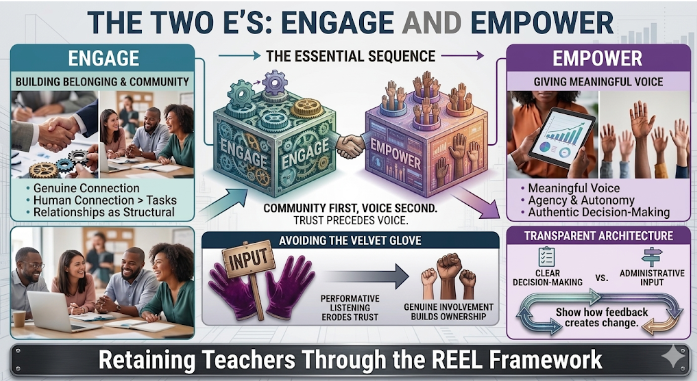
This is the tension the research keeps surfacing, and it is worth naming directly: doing engagement and doing empowerment — checking both boxes — does not produce the culture that keeps people. What produces that culture is understanding that the two are not separate programs. They are a sequence. Community has to exist before voice is safe, and voice has to produce real outcomes before community feels worth investing in. When that sequence breaks down, leaders are left with something that looks like both and functions as neither.
The belief underneath that breakdown is rarely examined because the effort feels genuine — and it is. What is missing is not investment but understanding: engagement designed around tasks quietly teaches people their presence is valued for their output, and that empowerment offered without relational foundation produces exactly the guarded, filtered participation that looks like voice but carries none of its weight.
The hopeful truth is that when leaders understand Engage and Empower as a sequence rather than a checklist.
Beliefs in Practice
What drives leader behavior is often belief sitting underneath the research. In schools, a handful of beliefs about community and voice show up so consistently they are worth naming directly.
The first is the most common: community can be scheduled. Annual events feel like enough because it looks like enough. And because that belief goes unexamined, the quiet disengagement happening in the months between events stays invisible.
A second belief runs through how many schools structure professional time: participation equals engagement. When staff meetings and PLCs get counted as community-building, a leader can feel satisfied about connection — while the teacher eating lunch alone in her classroom every day has technically attended every required gathering. Obligation fills the calendar, belonging doesn't.
Perhaps the most consequential belief is this: belonging will develop on its own if conditions are decent. Good leadership, reasonable workload, supportive administration — surely relationship forms as a byproduct. What the research interrupts is the assumption that community is the reward for a well-run school. Instead, it is the mechanism through which everything else actually becomes meaningful.
These beliefs are rarely held cynically. They formed because they seemed to work, or because no one named the gap between what was offered and what was needed. That is where this work begins: not with blame, but with an honest question about what we have assumed belonging requires — and whether those assumptions still hold.
Leadership Practice
The first move is not a program. It is a pause long enough to ask: what are we actually building here, and for whom?
Engage is about creating multiple entry points for connection — varied enough that every person in the building can find a way in that matches their capacity. A system that only creates high-visibility, high-commitment opportunities will capture the teachers who were already engaged and miss the ones most at risk of leaving.
Three practices make this concrete. Audit who your current opportunities are actually designed for — if the same ten people show up to everything optional, that is data about access, not enthusiasm. Design at least one low-commitment opportunity each month that requires nothing beyond a single contribution: a dish for a potluck, a two-question survey, a five-minute celebration built into a meeting that already exists. Vary the format deliberately — some teachers connect over food, others over a shared project, others over a walking group. No single format reaches everyone.
Empower is about making the connection between what teachers say and what actually changes visible enough that speaking feels worth the risk. The failure mode is the velvet glove — asking for input on a decision that was already made. It teaches teachers that voice is decorative, and that lesson is very difficult to unlearn.
Two practices interrupt this pattern. Name what is open before the conversation begins — what has been decided, what is genuinely open, and how teacher input will shape the outcome. Close the loop explicitly — when a recommendation drives a decision, say so out loud and in writing: you told us X, and here is what changed. That visible connection is what makes future participation feel worth the investment.
Community has to exist before voice is safe, and voice has to produce real outcomes before community feels worth investing in. When engagement is thin, start there. When a community exists but voice feels hollow, start with the transparency and loop-closing that rebuilds trust. In both cases, the work is noticing where in the sequence the breakdown is happening — and resisting the impulse to add more of what is already there.
System & Structure Lens
When engagement lives only in the social calendar and empowerment only in rhetoric, the system is already communicating what it values — whether that was the intention or not. Most leaders who find themselves here did not design it this way. The structures simply formed around other priorities, and community and voice never made it into the architecture. When leaders shift that design deliberately — building for Engage and Empower rather than around them — the system begins to say something different: that the people inside it matter, and that the structures exist to serve them.
The structural audit for Engage asks one honest question: who are our current entry points actually designed for? When community participation reliably favors teachers with more energy, more seniority, or more social ease, the system is selecting — quietly and without malice — against the teachers who most need a low-risk way in. Fixing that is a design decision, not a culture campaign.
The structural audit for Empower asks an equally direct question: where does teacher input actually go? Which committees carry real decision authority, and which are advisory regardless of what they are called? When the connection between what teachers say and what the institution does is invisible, the system teaches that participation is a performance. That lesson arrives through repeated experience — I spoke, and nothing moved — and it does not require anyone to say it out loud. Closing that loop, in writing, is what transforms participation from gesture into mechanism.
The deepest structural question underneath both: what does this school ask teachers to risk, and what has it built to make that risk worth taking? Community requires vulnerability. Voice requires courage. Systems that want both without building the conditions that make them survivable are asking teachers to spend something the institution has not yet earned the right to request. The record that earns it is built slowly — one protected entry point, one closed loop, one decision visibly shaped by teacher input at a time.
Reflect. Connect. Grow.
Reflect. Think of a time you asked for teacher input on a decision that was already largely settled. What did you believe you were offering? What were teachers actually receiving?
Connect. When engagement opportunities favor the teachers who always step forward, who is quietly left at the edges? What would it take to design something they could actually step into?
Grow. What is one moment in the next thirty days where you could make the connection between what was heard and what was decided visible — and let that moment be the beginning of something?
Looking Forward
Teachers stay where they feel they belong, and where they believe their contributions matter. But underneath that finding is a belief question: do I actually believe that community and voice are the work — or do I believe they are nice additions to the real work? That belief shapes what gets resourced, what gets protected when time is short, and what quietly disappears under pressure.
The next entry introduces the fourth domain of the REEL framework: Learn. Not professional development in the traditional sense, but something broader and more human — the belief that teachers, like the students they serve, grow when they are given space to pursue what genuinely interests them.
References
Aguilar, E. (2018). Onward: Cultivating emotional resilience in educators. Jossey-Bass.
Heifetz, R. A., Linsky, M., & Grashow, A. (2009). The practice of adaptive leadership. Harvard Business Review Press.
Pahl, A. L. (2022). Addressing teacher attrition through trauma-informed practices in the workplace (Publication No. 714) [Doctoral dissertation, Minnesota State University Moorhead]. RED: Repository for Educational Documentation.
