
July 2026 Series: Connection First (Entry 1: Conditions Before Strategy)
Jul 02, 2026
Conditions Before Strategy
Safety, Belonging, Trust, Clarity, Purpose, and Accountability
Connection First Series — Week 1 of 5 By Janine Gacke
Estimated read time: ~8 minutes
Most leaders are not short on strategy. They have plans, priorities, and data. They have teams, professional learning days, timelines, dashboards, protocols, and clearly communicated expectations. And still, the work can stall, not because people do not care, not because the strategy is weak, and not always because the plan was wrong.
Sometimes the work stalls because the conditions for carrying it together were never built. This is where the Connection First series begins.
Connection First is a leadership framework for building human systems that sustain change. It begins with the belief that meaningful implementation is not only technical; it is relational, organizational, and human. Strategies do not move through systems on their own. They move through people, teams, routines, relationships, trust, clarity, capacity, and shared ownership. When those human conditions are weak, even strong strategies can become fragmented. When those conditions are intentionally built, strategy has a better chance of becoming consistent practice.
The Connection First framework is organized around five connected domains: Conditions, Relationships, Practice, Capacity, and Sustainability. These domains help leaders examine the space between what a system knows and what a system can actually do. That space is central to the Making Champions of Change From Knowing to Doing framework: leaders may know the priority, know the evidence, know the desired outcome, and know the plan, but implementation depends on whether the system has built the conditions, relationships, practices, capacity, and structures needed to carry the work over time.
We begin with Conditions because every other domain depends on them. Relationships are difficult to strengthen without safety and trust. Practice is difficult to make consistent without clarity and purpose. Capacity is difficult to build when people do not feel safe naming what they do not yet know. Sustainability is difficult to protect when accountability is not paired with belonging, support, and shared ownership.
So the series begins with a claim that often sounds soft and is not:
Conditions are implementation infrastructure.
Before a strategy can become consistent practice, people need an environment where they can understand why it matters, ask honest questions, name what is not working, and trust that doing so is safe. Research on psychological safety has shown that learning behavior depends on whether people believe they can take interpersonal risks — asking questions, admitting uncertainty, naming mistakes, or offering dissent — without fear of being punished or diminished (Edmondson, 1999, 2019). In schools, relational trust also functions as a resource for improvement, shaping whether adults are willing to engage in the vulnerable work of changing practice together (Bryk & Schneider, 2002).
Over the next five weeks, this series moves through the five domains of the human system: Conditions, Relationships, Practice, Capacity, and Sustainability. But we start here, because conditions shape whether people can engage honestly in any of the work that follows.
When implementation stalls, the first move is not always more direction.
It is to ask what conditions are surrounding the work.
The Human Experience of Conditions
Picture a district launching a new instructional framework, or a building recommitting to Tier 1 practices. On paper, the work makes sense. But when the plan enters the real system, something shifts. One team moves forward quickly; another waits for more direction. Some staff ask questions; others go quiet. Some feel energized; others feel that one more thing has been added to a system that is already heavy.
These differences are easy to read as inconsistency, resistance, or weak follow-through. More often, they are the conditions speaking. When conditions are weak, people hesitate to ask questions, disagreement moves into the hallway instead of the room, and adults protect themselves rather than learn together. Expectations land as pressure, clarity depends on who you happen to ask, and accountability feels punitive — so people comply without committing.
When conditions are stronger, the same system behaves differently. People understand the purpose behind a priority, not just the expectation attached to it. Staff can name a barrier without fear it will be held against them. Belonging shows up in who actually participates. Accountability is paired with support, and leaders can hear what the system needs before adding more. The strategy hasn't changed. The conditions surrounding it have transformed.
Leadership Practice in the Moment
Conditions are not built because leaders value people. They are built when leaders behave in ways that make safety, clarity, and trust more possible — usually in small, unremarkable moments. A leader clarifies the purpose of a priority before reviewing anyone's performance against it. A leader names what has already been decided and what is genuinely still open, so people are not left guessing. A leader asks what staff need in order to implement well, and pauses before reading silence as resistance.
The discipline underneath these moves is restraint — a stance our April series on adult learning named directly: staying with what people are actually saying long enough to understand it, rather than moving immediately to solve, reassign, or reframe. Accountability still belongs here; conditions work is not the absence of expectations. But when accountability arrives without clarity, trust, or support, it tends to become pressure, and people comply without committing. When it is paired with those conditions, it can become shared ownership. Psychological safety research makes the mechanism plain: people take the interpersonal risks that learning requires — admitting uncertainty, asking for help — only when they trust those risks will not be used against them (Edmondson, 2019).
System & Structure Lens
A leader can model strong conditions and still be working inside a system that quietly undercuts them.
That is why Conditions is a design question, not only a relational one.
When expectations are unclear, people compensate on their own — and the most relational, conscientious staff tend to absorb the most hidden labor. When accountability outpaces capacity, people are held to a standard the system has not resourced them to meet. When the purpose of a priority is assumed rather than repeatedly clarified, people may comply with tasks without understanding the deeper reason the work matters.
The leadership question shifts from:
“Why aren’t people doing this?”
to:
“Where is the system making honest, consistent work difficult — and which condition has to be strengthened before the strategy can take root?”
This is the space between what a system knows and what it can actually do — the gap at the center of the From Knowing to Doing frame. That space is not empty. It is filled with trust, clarity, belonging, readiness, history, fatigue, and capacity. These are not distractions from implementation; they are part of implementation.
Implementation research consistently points to the importance of the conditions surrounding practice. Improvement efforts are more likely to take hold when systems attend to local context, learn through disciplined cycles, and build the organizational capacity to adapt as they go (Bryk et al., 2015). Coherence is also not produced by a plan alone; it is cultivated through shared understanding, aligned priorities, and leadership practices that help separate efforts add up to a common direction (Fullan & Quinn, 2016).
This matters because leaders often respond to implementation gaps by adding more: more communication, more reminders, more monitoring, more training, more tools. Sometimes more is needed. But often, the system first needs greater clarity, stronger trust, safer participation, or a more coherent structure for adults to make sense of the work together.
Relational trust functions as a measurable resource for school improvement rather than a nicety (Bryk & Schneider, 2002). Psychological safety supports the learning behaviors that complex implementation requires, including asking for help, surfacing concerns, and discussing mistakes openly (Edmondson, 1999, 2019). Sensemaking research reminds us that people do not simply receive change; they interpret it through prior experience, relationships, identity, language, and context (Weick, 1995). Adult learning research similarly reinforces that sustained growth requires space for reflection, interpretation, and connection to lived practice rather than information transfer alone (Mezirow, 1991).
Connection First brings these ideas together in a practical leadership frame.
It asks leaders to examine the human system beneath the strategy.
Not to slow the work unnecessarily. Not to avoid accountability. Not to make implementation only about feelings.
But to help leaders act with greater precision. The issue may not be that people do not understand the plan.
The issue may be that the system has not yet built the conditions that allow the plan to become shared, supported, and sustainable practice.
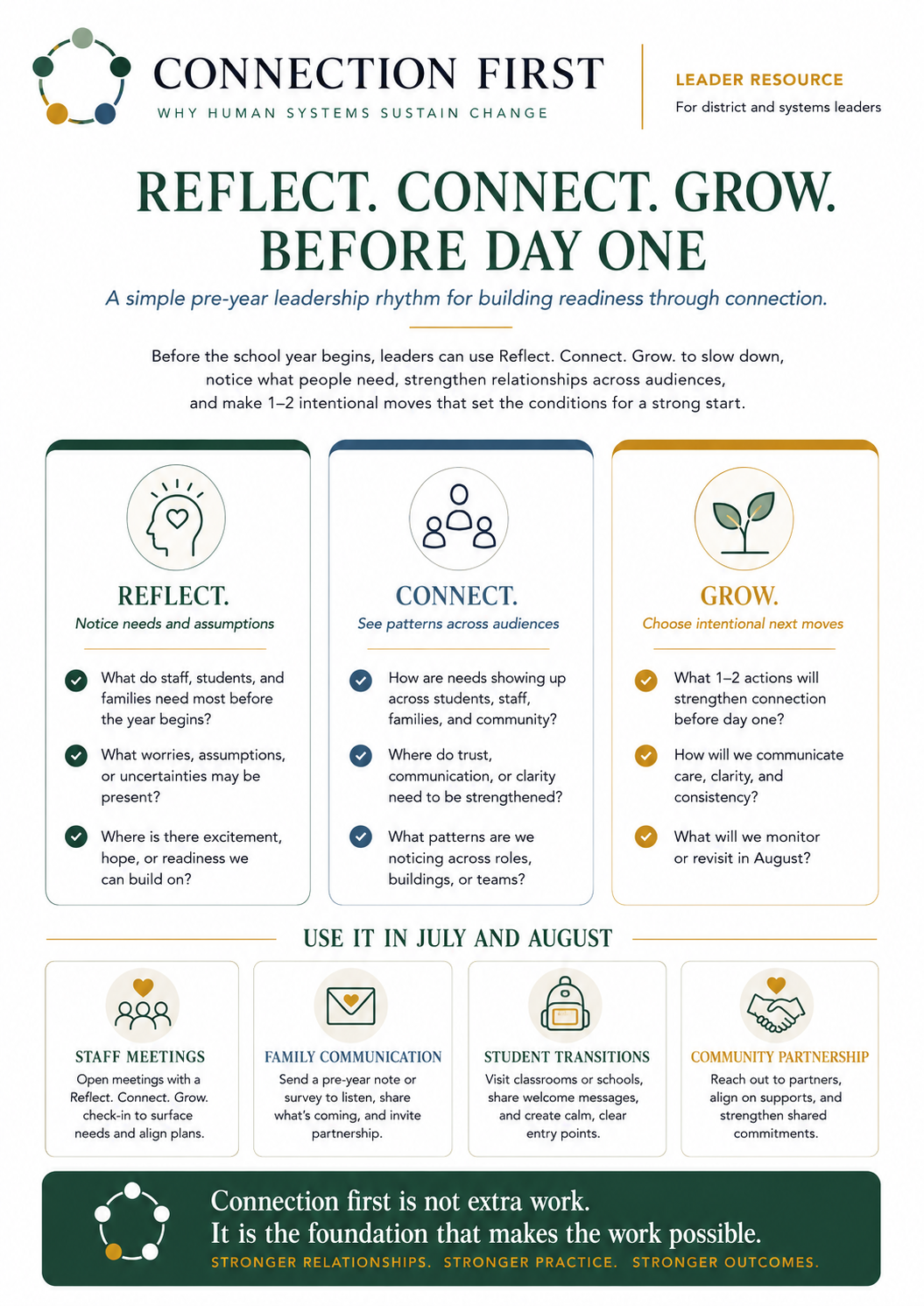
Reflect. Connect. Grow.
Reflect. What feels steady, and what feels strained, in the conditions surrounding a current priority? Where might you be reading a condition gap as a people problem?
Connect. Where does this pattern show up across roles, teams, or buildings? Who is quietly compensating for a lack of clarity, safety, or support?
Grow. What is one small shift that would strengthen the conditions for honest participation and consistent practice — before adding more direction?
Looking Forward
Conditions are the environment that makes honest engagement possible. But an environment is not yet a relationship. A team can have clarity and safety and still struggle to stay connected when the work becomes genuinely hard — when there is disagreement to work through, strain to repair, or ownership to share. That is where next week turns. Conditions create the space for people to engage; relationships determine whether they can stay connected through complexity. Sustainable change begins beneath the strategy.
References
Bryk, A. S., Gomez, L. M., Grunow, A., & LeMahieu, P. G. (2015). Learning to improve: How America’s schools can get better at getting better. Harvard Education Press.
Bryk, A. S., & Schneider, B. (2002). Trust in schools: A core resource for improvement. Russell Sage Foundation.
Edmondson, A. C. (1999). Psychological safety and learning behavior in work teams. Administrative Science Quarterly, 44(2), 350–383.
Edmondson, A. C. (2019). The fearless organization: Creating psychological safety in the workplace for learning, innovation, and growth. Wiley.
Fullan, M., & Quinn, J. (2016). Coherence: The right drivers in action for schools, districts, and systems. Corwin.
Mezirow, J. (1991). Transformative dimensions of adult learning. Jossey-Bass.
Weick, K. E. (1995). Sensemaking in organizations. SAGE.
