
Learning With Adults: Dignity, Agency, and the Work of Becoming (Learning Entry 3: Designing Professional Learning)
Apr 15, 2026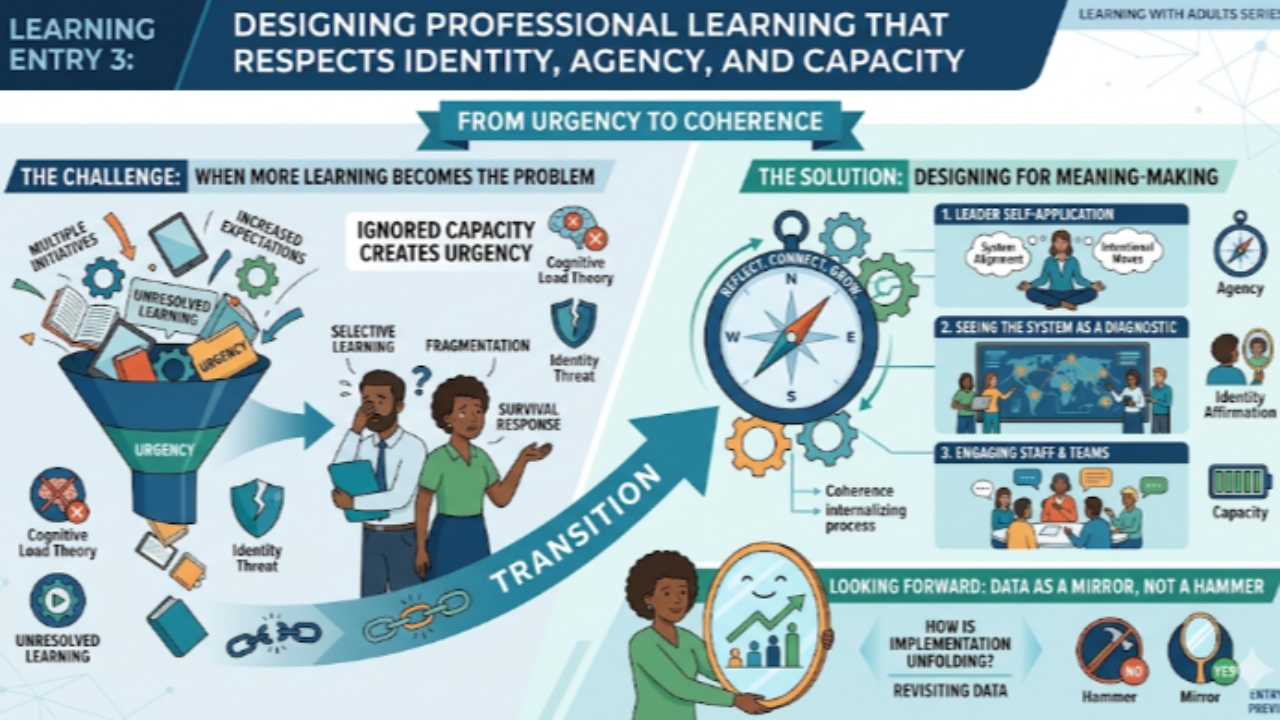
Designing Professional Learning That Respects Identity, Agency, and Capacity
By Dr. Amy Pahl and Dr. Morgan Goering
April Series: Learning With Adults: Dignity, Agency, and the Work of Becoming
Estimated read time: ~8 minutes
Learning as Transformation, Not Transmission: When More Learning Becomes the Problem
When professional learning ignores capacity, it creates urgency. When it honors capacity, it creates coherence. In many systems, when outcomes stall or implementation feels uneven, the response is both immediate and familiar: More professional learning. Additional sessions are scheduled. New resources are introduced. Expectations are clarified with increasing precision and urgency. These moves are grounded in care; leaders are trying to respond to challenges and ensure staff have the support they need to succeed.
And yet, over time, a different pattern emerges. The calendar fills, the messaging expands, and the volume of learning increases—but coherence does not. Instead, educators find themselves navigating multiple streams of input—new strategies, revised expectations, layered initiatives—while managing the daily complexity of their roles. What was intended as support begins to feel like accumulation.
This happens not because the learning is wrong, but because the conditions for receiving it have been overlooked. This is the tension at the center of design:
- When systems encounter challenges, they often respond by adding.
- When adults encounter overload, they often respond by narrowing or avoiding.
Learning does not disappear in these moments; it simply becomes selective, surface-level, or deferred. This isn’t a rejection of the work—it is a survival response to capacity. If adult learning is a process of meaning-making shaped by identity, then professional learning cannot be a continuous stream of input. It must be a process that adults can engage with, interpret, and integrate over time.
Adult Learning Reality: Capacity Is Not a Limitation. It Is a Condition.
Adults do not learn in isolation. They engage with new ideas within the context of competing demands, cognitive load, and emotional energy. This isn't a matter of motivation; it is a matter of capacity. Cognitive Load Theory explains why even the most "gold-standard" PD can fail when too much is introduced at once (Sweller, 1988). When new information competes with unresolved prior learning, the brain’s ability to process deeply is reduced. Educators may understand the what, but they lack the structural "breathing room" to integrate the how.
This is where identity and capacity collide. When initiatives are layered without space for reflection, adults aren't given the chance to reconcile new ideas with their existing professional beliefs. The result is fragmentation: pieces of learning exist, but they do not connect. Amy’s work in alternative environments reinforces that when learning is relevant and timely, engagement increases—not because expectations are lower, but because the learning fits the educator’s reality. While Morgan’s work reflects a parallel insight: coherence isn't achieved through louder messaging; it’s achieved by reducing competing demands so that what remains can be engaged deeply. Capacity, then, is not a barrier to learning. It is the very condition that makes learning possible.
Leadership & Coaching Practice: From Delivering More to Designing for Meaning
If capacity is a condition for learning, leadership must shift from delivering more to designing for meaning. This requires a different kind of discipline. The instinct to respond quickly—to close gaps and add support—is strong, especially under pressure. However, speed and volume often interrupt the very understanding they seek to create. Leaders who design effectively begin by slowing the process down. They create a pause for adults to engage with learning before adding the next layer. They recognize that without time for interpretation, even high-quality learning remains external to practice. This is where a consistent structure becomes essential. Not another tool or initiative, but a shared way of holding the work.
Reflect. Connect. Grow. as a Multilevel Leadership Practice
Reflect. Connect. Grow. is more than a facilitation strategy; it is a multilevel leadership practice. It serves three interconnected purposes:
- For Leaders: A way to slow thinking and make intentional decisions.
- For the System: A diagnostic lens to see patterns and areas of strain.
- For Staff: A consistent structure that honors identity, agency, and capacity.
Level 1: Leader Self-Application
Before passing new learning to the staff, leaders must engage with it themselves:
- Reflect: What is this bringing up in my understanding of our system? What feels clear, and what feels uncertain?
- Connect: How does this align with what I am seeing across teams, data, and current initiatives?
- Grow: What is one intentional move that supports coherence rather than adding complexity?
When leaders skip this step, they unintentionally pass their own urgency forward to the staff.
Level 2: Seeing the System as a Diagnostic
Leaders can then use the framework to interpret the organization’s health:
- Reflect: Where are teams already reflecting? Are there identities or feelings being unaddressed?
- Connect: Where is the system experiencing strain due to competing demands? What resources are working and can be shared or leveraged by other parts of the organization?
- Grow: Where can better conditions or relationships be cultivated to increase the successful effort of the adults of the system?
Here, the framework is a mirror for the system, not just a tool for individuals.
Level 3: Engaging Staff and Teams
Once the leader engages in the diagnostic practice and shares any needed learning with the adults who are building shared lift of the initiatives, the framework then becomes the shared language for processing professional learning, teaming, or coaching sessions. Whether in a staff meeting or a PLC, the moves remain the same:
- Reflect: Ground in sense-making and identity.
- Example: What are you noticing in your practice? What feels aligned or challenging?
- Connect: Allow for pattern recognition and contextual experience to highlight celebrations, leverage points, connections to prior learning, and potential barriers.
- Example: Where are you seeing this across students, teams, or classrooms?
- Grow: Plan for the small action steps that will get the practice started as soon as the learning is stored.
- Example: What is one small shift you are ready to try?
This consistency matters. When adults encounter the same structure across settings, learning becomes more predictable, more accessible, and more connected. It reduces cognitive load while increasing depth.
Why This Matters
Systems do not need more tools; they need fewer, used with greater consistency and intentionality. When Reflect. Connect. Grow. is embedded across every level of an organization; it transforms the learner's experience from one of accumulation to one of coherence.
This framework serves as a systemic brake, slowing the reflexive tendency to pile on initiatives and replacing it with a disciplined practice of noticing, interpreting, and acting with intention. In this environment, learning is no longer a product to be delivered—it is a process to be internalized.
System & Design Lens: Coherence Over Accumulation
At the system level, the challenge is rarely the absence of strong ideas; it is the accumulation of too many ideas without a structure for integration. When initiatives layer and time remains constant, fragmentation is inevitable.
Leaders must make the critical shift:
- From: What else do we need to provide?
- To: What do we need to slow down, connect, or remove so learning can take hold?
This requires prioritization over addition, pacing over urgency, and coherence over coverage. When a system returns to a shared, repeatable structure like Reflect. Connect. Grow., the cognitive and relational load decreases. Learning deepens and becomes sustainable because it is being processed—not just delivered.
Reflect. Connect. Grow.
- Reflect: Where might our current professional learning efforts be adding more than they are integrating? How are our adults actually experiencing the pace right now?
- Connect: What patterns are emerging across teams? Where do we see authentic alignment, and where do we see protective fragmentation?
- Grow: What is one shift we could make to slow down, create space for meaning-making, and support more intentional implementation?
Looking Forward
When professional learning is designed to honor identity, agency, and capacity, it becomes sustainable. Adults translate learning into practice because they finally have the space to do so.
But one critical question remains: How do we know if what we are implementing is being experienced as intended? In our next entry, we revisit Data. We will explore data not as a measure of failure, but as a mirror—a way to reflect on implementation and guide learning without turning it into judgment. Because systems do not need more tools; they need the intentional use of the ones they already have.
References
Deci, E. L., & Ryan, R. M. (2000). The “what” and “why” of goal pursuits: Human needs and the self-determination of behavior. Psychological Inquiry, 11(4), 227–268.
Edmondson, A. C. (2019). The fearless organization: Creating psychological safety in the workplace for learning, innovation, and growth. Wiley.
Goering, M. A. (2026). Reflect. Connect. Grow.: Adult learning design framework. Leadership Knowledge Commons, Making Champions of Change.
Knowles, M. S. (1984). The adult learner: A neglected species (3rd ed.). Gulf Publishing.
Mezirow, J. (1997). Transformative learning: Theory to practice. New Directions for Adult and Continuing Education, 74, 5–12.
Sweller, J. (1988). Cognitive load during problem solving: Effects on learning. Cognitive Science, 12(2), 257–285.
