
May 2026 Series: The Work Between Us (Entry 4: Collaboration as Belonging Practice)
May 28, 2026
Healing Spaces: Collaboration as a Belonging Practice
Belonging is not an extra layer on top of collaboration. It is one of the conditions that determines whether collaboration can hold through strain.
By Dr. Morgan Goering and Dr. Amy Pahl
Estimated read time: ~8-10 minutes
Some collaborative spaces feel efficient long before they feel safe. The agenda moves, the norms are posted, and the team appears aligned, yet underneath that order, people are often still deciding how much of themselves it is wise to bring into the room. They carry past experiences of being ignored, corrected, left out, or reduced to a performance metric. In those settings, collaboration can continue procedurally while remaining relationally thin.
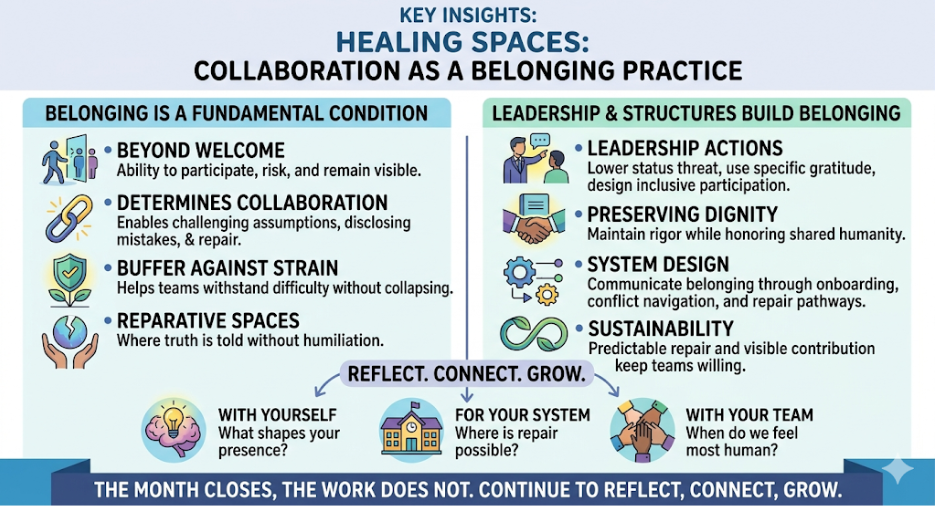
This is why belonging matters so much to our shared work. Belonging is not simply feeling welcome; it is the experience of being able to participate, risk, and remain visible without being diminished by the process. When belonging is weak, collaboration narrows. People may still comply, but they are far less likely to challenge assumptions, disclose mistakes, engage in repair, or stay open through organizational difficulty. When belonging is strong, collaboration becomes more than coordination. It becomes a space where shared work can also hold our shared humanity.
Collaboration in Practice
Research on belonging helps explain why this dynamic is so powerful. Walton and Cohen (2007, 2011) demonstrate that belonging uncertainty deeply shapes how people interpret adversity, risk, and social information. When educators are unsure whether they fit or will be accepted, everyday professional strain takes on a punitive meaning. In collaborative settings, that uncertainty determines whether disagreement feels like a productive friction or a dangerous threat. Edmondson’s (1999) foundational work on psychological safety similarly shows that teams engage more fully in learning behaviors when the group feels safe for interpersonal risk-taking. Furthermore, Bryk and Schneider’s (2002) research on relational trust reminds us that school improvement is driven by the quality of social relationships, not just by technical plans.
Restorative-practice research adds a layer of both caution and hope to this conversation. Systematic reviews suggest that restorative approaches in schools are associated with promising outcomes related to school climate, stronger relationships, and reductions in exclusionary discipline, while simultaneously showing that implementation quality is everything (Lodi et al., 2021; Zakszeski & Rutherford, 2021). This means belonging is not created by sentiment or by declaring a culture goal. It is forged through repeated relational and structural practices that make participation, repair, and accountability possible.
This is why the phrase healing spaces needs careful handling. A collaborative space is not automatically healing because it is warm. It becomes reparative when people can tell more truth there than they could before, when harm can be addressed without humiliation, and when the system teaches that belonging and responsibility are not opponents.
Leadership and Facilitation Practice
Amy’s leader-learner story offers a clear lens into this work. Her own experience as an educator and learner taught her what it feels like to live in the gap between potential and support—to be deeply capable, fully committed, and still not completely seen by the system. That history shaped how she now approaches adults and students who might otherwise go unnoticed. The lesson here is larger than one biography: people enter collaborative spaces carrying long histories of visibility and invisibility, and those histories influence how they show up today.
Leaders strengthen belonging when they notice precisely, not vaguely. This means moving beyond generic praise and paying disciplined attention to the actual dynamics in the room—acknowledging invisible labor, naming specific persistence, and intentionally tracking whose ideas are taking root and whose remain at the edges. When leaders do this they make room for entry, choosing to revisit norms after strain rather than only when building them for the first time, thereby creating pathways to repair without reducing people to their hardest moments.
In practical collaborative terms, this looks like opening meetings in ways that lower status threat, using restorative questions when tension rises, making gratitude specific rather than generic, and designing participation so the room does not belong only to the fastest or most confident voices. Crucially, this intentional design is not the removal of rigor; it is the preservation of dignity while high expectations remain present. Belonging becomes strongest when people are asked to contribute meaningfully and are deeply supported in doing so. The room should never ask less of people in order to feel safe—it must simply become more skillful at holding what the work asks of them.
System and Structure Lens
Belonging is often discussed as though it appears naturally whenever people are kind enough, but school systems actually teach belonging through design. Systems communicate belonging through how new people are onboarded, how conflict is navigated, how decisions are explained, how gratitude is expressed, and whether repair is structurally possible after missteps. A system that values belonging must make those practices visible and repeatable.
This is where collaboration becomes sustainability work. Teams stay willing to work through complexity when they know the room can hold tension without collapsing into blame or withdrawal. Trust deepens when contribution is noticed, when repair is predictable, and when the work does not require people to disappear parts of themselves to remain involved. In this sense, belonging is not a soft ending to the collaboration conversation. It is the exact reason collaboration can survive systemic strain at all.
The leadership challenge, then, is to design collaborative spaces that are honest enough for accountability, safe enough for voice, and relationally steady enough for repair. That combination is demanding, but it is precisely where real systems work begins.
Reflect. Connect. Grow.
Read more about the Reflect. Connect. Grow. Adult Learning Design Framework here.
With yourself
- Reflect: What experiences have shaped how much of myself I tend to bring into collaborative spaces?
- Connect: How do I react when a room becomes tense, vulnerable, or uncertain?
- Grow: What is one way I can increase dignity, precision, or repair in the spaces I help hold?
For your system
- Reflect: Where does our system ask people to collaborate without fully protecting voice, visibility, or repair?
- Connect: What patterns do we see between trust, participation, follow-through, and who feels they belong here?
- Grow: What one routine or response could strengthen belonging without lowering accountability?
With your system
- Reflect: When does this team feel most human, and when does it feel most guarded?
- Connect: What do our current practices teach people about voice, risk, and repair?
- Grow: What is one concrete move we can make together to strengthen collaboration as a place of both responsibility and belonging?
Looking Forward
The month closes here, but the work does not. The strongest follow-through is likely to come from packaging the series into a usable playbook, linking readers to one clean next step, and continuing to treat Reflect. Connect. Grow. as the closing discipline that helps collaboration remain thoughtful rather than performative.
References
- Bryk, A. S., & Schneider, B. (2002). Trust in schools: A core resource for improvement. Russell Sage Foundation.
- Edmondson, A. C. (1999). Psychological safety and learning behavior in work teams. Administrative Science Quarterly, 44(2), 350-383. https://doi.org/10.2307/2666999
- Lodi, E., Perrella, L., Lepri, G. L., Scarpa, M. L., & Patrizi, P. (2021). Use of restorative justice and restorative practices at school: A systematic literature review. International Journal of Environmental Research and Public Health, 19(1), Article 96. https://doi.org/10.3390/ijerph19010096
- Walton, G. M., & Cohen, G. L. (2007). A question of belonging: Race, social fit, and achievement. Journal of Personality and Social Psychology, 92(1), 82-96. https://doi.org/10.1037/0022-3514.92.1.82
- Walton, G. M., & Cohen, G. L. (2011). A brief social-belonging intervention improves academic and health outcomes of minority students. Science, 331(6023), 1447-1451. https://doi.org/10.1126/science.1198364
- Zakszeski, B., & Rutherford, L. E. (2021). Mind the gap: A systematic review of research on restorative practices in schools. School Psychology Review, 50(2-3), 371-387. https://doi.org/10.1080/2372966X.2020.1852056
