July 2026 Series: Connection First (Entry 2: Relationships That Hold The Work)
Jul 09, 2026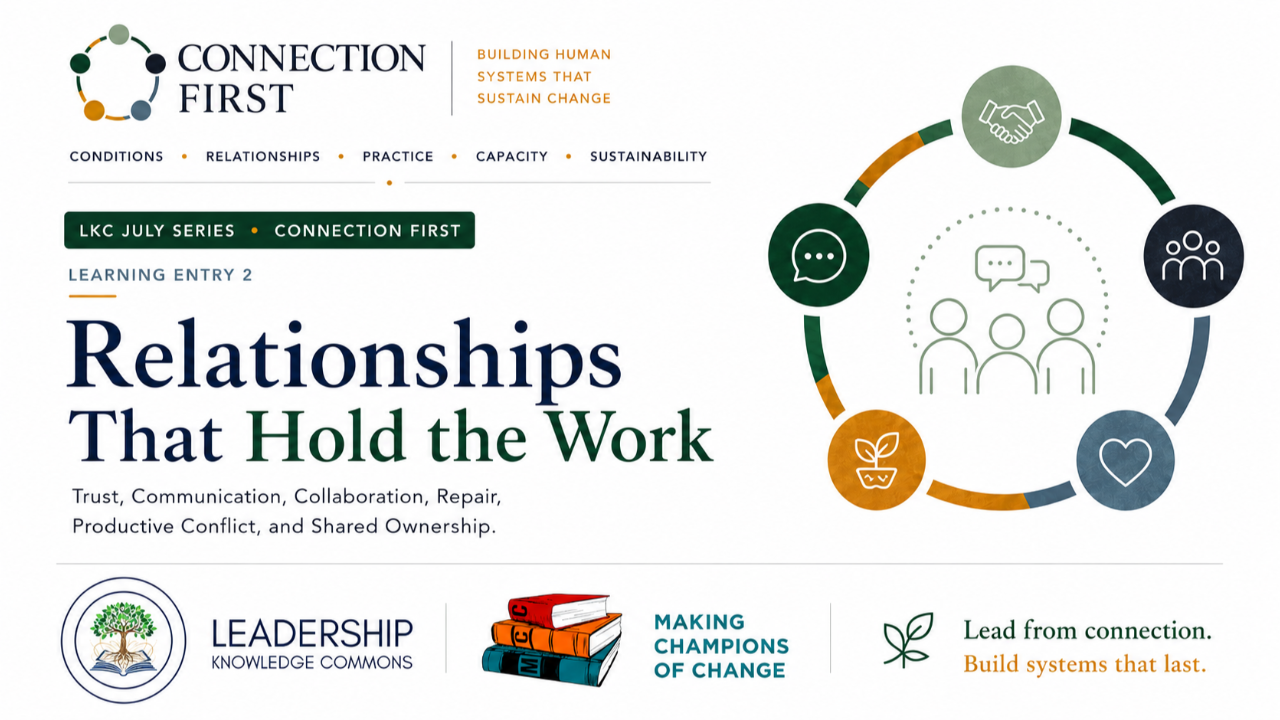
Relationships That Hold the Work
Trust, Communication, Collaboration, Repair, Productive Conflict, and Shared Ownership
Connection First Series - Week 2 of 5 By Janine Gacke
Estimated read time: ~7 minutes
Relationships are not separate from implementation. Relationships are how systems carry complexity.
Most leaders can recognize the pattern. The team meets regularly. The agenda is full. People are respectful. Updates are shared. Decisions may even be named before the meeting ends.
Then the real conversation happens afterward.
A principal, a coach, and a district leader each hear the same priority differently — and three buildings begin carrying it three ways. Some move quickly, some wait, some agree publicly and hesitate privately, while a few relationships quietly hold the work together and the system stays unclear.
On the surface this looks like weak follow-through. But Connection First asks a different question: are the relationships strong, clear, and trusted enough to hold the complexity of the work?
People do not act on information alone. They act on the meaning they build together through conversations, routines, relationships, and repeated experience (Argyris & Schön, 1978; Weick, 1995).
RELATIONSHIPS ARE IMPLEMENTATION INFRASTRUCTURE
Relationships are often treated as the culture work that happens before the real work begins. Connection First frames them differently. Relationships are not separate from implementation — they are how implementation happens.
People make sense of change through other people: they interpret priorities through conversation, decide whether to ask for help based on trust, surface barriers when it feels safe enough to, and stay engaged in hard work when they believe they aren't carrying it alone (Bryk & Schneider, 2002; Edmondson, 1999). None of this replaces clarity, structure, or accountability. Relationships actually grow stronger when clear routines, decision rights, communication pathways, and follow-through support them.
Connection is not niceness. Connection is infrastructure. It is the relational system through which trust, communication, collaboration, repair, productive conflict, and shared ownership move — the reason improvement depends on people learning together over time rather than simply receiving information and complying with it (Bryk et al., 2015).
LEADERSHIP PRACTICE IN THE MOMENT
Because relationships carry implementation, leaders build them in the small moments where meaning is made.
The principal says, “I am not going to read quiet as agreement. What are we not yet saying?” A coach asks, “Is this an individual problem, or is this a pattern the system is producing?” A district leader closes a feedback loop by saying, “Here is what we heard, here is what we can adjust now,” while also explaining what can’t be changed and why. The leadership team pauses after a difficult meeting and names the strain directly instead of moving immediately to the next agenda item.
These moves are not complicated, but they are disciplined. They communicate that trust, communication, repair, and shared ownership are not extras. They are part of how the system does the work.
WHAT LEADERS OFTEN MISREAD
When relationships are strained or underdeveloped, leaders may misread what they are seeing.
Politeness may be mistaken for trust, silence may be mistaken for alignment, and side conversations may be mistaken for negativity. Conflict can be mistaken for dysfunction, avoidance for apathy, and a system's dependence on one or two people for leadership strength.
While sometimes those interpretations contain some truth they are often incomplete.
The polite team may be avoiding the hard conversation; the staff member raising concerns may be protecting the work from drift; the side conversation may be signaling that the main one doesn't yet feel safe or honest enough. Even conflict is often a sign that the work matters and the team simply lacks the structures to disagree well.
This is the pattern beneath the misreadings: people withhold concerns when speaking up feels risky or unlikely to change anything (Morrison, 2014), and they ask questions, admit uncertainty, and surface errors only when it feels safe to do so (Edmondson, 1999). What looks like a people problem is usually the relational system shaping how people communicate, disagree, and repair.
Connection First helps leaders move from reaction to interpretation — from "Why aren't people aligned?" to "What relationship conditions are shaping how people communicate, disagree, repair, and own the work together?"
This is why the gap between knowing and doing is relational, not only technical. A system can hold the right strategy and still stall when communication is guarded, trust is uneven, repair is avoided, and ownership sits with too few people — because relationships shape whether people believe the process is credible, feel safe enough to name barriers, and stay engaged when the work gets hard. Connection First helps leaders read those relational conditions as the thing to strengthen, rather than adding pressure to a system that is already carrying strain.
THE RELATIONSHIP CONDITIONS THAT HOLD THE WORK
The Relationship domain includes trust, communication, collaboration, repair, productive conflict, and shared ownership. These are not abstract values. They are daily implementation conditions.
Trust grows through repeated evidence that people can count on one another: consistency, honesty, competence, care, and follow-through. When it's weak, people withhold questions and soften feedback; when it's strong, they tell the truth early enough for the system to respond (Bryk & Schneider, 2002).
Communication is not sending information but building shared understanding — when it's unclear or travels informal channels, people fill the gaps themselves and access becomes uneven.
Collaboration is more than meeting together; it's shared thinking with clear roles and decisions that move into action (Coleman, 1988; Leana & Pil, 2006).
Repair lets relationships continue after strain — naming what happened, attending to impact, and following through, not apology alone; systems that avoid it carry hidden strain that resurfaces as guardedness or drift.
Productive conflict uses tension for learning rather than avoiding it: psychological safety is not the absence of disagreement but what makes disagreement usable (Edmondson, 1999).
Shared ownership means the work doesn't depend on one champion — it grows when leaders distribute responsibility, revisit commitments, and make follow-through visible (Bandura, 1997; Donohoo, 2017).
RELATIONSHIPS BEFORE THE WORK ACCELERATES
July and August are not only condition-setting months — they are relationship-setting months. Relationships strengthened before pressure increases are the ones most likely to hold when implementation gets hard; relational trust, collective efficacy, and psychological safety all point to the same practical insight: people engage honestly and persist through complexity when they believe the work is credible, shared, and safe enough for real learning (Bryk & Schneider, 2002; Donohoo, 2017; Edmondson, 1999). Before the pace accelerates, the most useful thing a leader can do is pause and look honestly at where relationships stand.
We’ve included a quick one-page resource, Relationships Before the Work Accelerates, for pausing before the beginning of the school year. Remember the power in pausing allows us to reflect without passing judgment, engage in sense-making, and grow through identifying your next relationship move to make now that will pay dividends over time.
REFLECT. CONNECT. GROW.
Reflect.
- Where are relationships currently helping the work move, and where are they under strain?
- Where might you be mistaking politeness for trust or silence for alignment?
- What relationship pattern are you noticing but not yet naming?
A one-page companion, Relationships Before the Work Accelerates, can guide this pause before the year begins — a place to reflect without judgment, make sense of what you're seeing, and name the next relationship move worth making now.
Connect.
- Where do trust, communication, or repair patterns show up across roles, teams, buildings, or partners?
- Where are side conversations carrying information that should be surfaced in the main conversation?
- Where are relationships carrying weight that structures or routines should also support?
Grow.
- What is one relationship move that could strengthen trust, communication, or shared ownership this month?
- What conversation, clarification, or repair needs to happen before the work accelerates?
- What routine could help this team stay connected when the work becomes difficult?
LOOKING FORWARD
Relationships help the system carry complexity. But relationships alone are not enough. The work must become visible in daily practice, and people must have the capacity to do that practice well.
Next week, we move into Practice: how purpose becomes observable, how expectations become routines, and how leaders build the support people need to implement consistently.
Conditions create the environment. Relationships hold the complexity. Practice makes the work visible in daily action.
Sustainable change begins beneath the strategy.
References
Argyris, C., & Schön, D. A. (1978). Organizational learning: A theory of action perspective. Addison-Wesley.
Bandura, A. (1997). Self-efficacy: The exercise of control. W. H. Freeman.
Bryk, A. S., Gomez, L. M., Grunow, A., & LeMahieu, P. G. (2015). Learning to improve: How America’s schools can get better at getting better. Harvard Education Press.
Bryk, A. S., & Schneider, B. (2002). Trust in schools: A core resource for improvement. Russell Sage Foundation.
Coleman, J. S. (1988). Social capital in the creation of human capital. American Journal of Sociology, 94(Supplement), S95–S120.
Daly, A. J. (Ed.). (2010). Social network theory and educational change. Harvard Education Press.
Donohoo, J. (2017). Collective efficacy: How educators’ beliefs impact student learning. Corwin.
Edmondson, A. C. (1999). Psychological safety and learning behavior in work teams. Administrative Science Quarterly, 44(2), 350–383.
Leana, C. R., & Pil, F. K. (2006). Social capital and organizational performance: Evidence from urban public schools. Organization Science, 17(3), 353–366.
Morrison, E. W. (2014). Employee voice and silence. Annual Review of Organizational Psychology and Organizational Behavior, 1, 173–197.
Weick, K. E. (1995). Sensemaking in organizations. Sage.
