
June 2026 Series: The Human Side of Teacher Retention (Entry 2: Restore as a Systemic Leadership Commitment)
Jun 11, 2026
June Learning Series: The Human Side of Teacher Retention
Restore as a Systemic Leadership Commitment
Estimated read time: - 6 to 8 minutes
There is a belief so common in school leadership that it rarely gets examined: if we offer wellness support, we have addressed teacher wellbeing. It shows up in the rhythmic, well-intentioned routine most districts know well — a breathing exercise in the October newsletter, an EAP reminder in January, a healthy recipe in April. These efforts are genuine and have an important place. And they are not enough.
The gap most leaders recognize when they step back is not one of effort or care. It is one of scale. A quarterly newsletter is individual, sporadic, and optional. The challenge facing teachers is systemic, continuous, and universal. Offering a breathing exercise to an educator operating in a state of emptiness is not sufficient because it is a bad idea. It is insufficient because it addresses a structural problem as though it were a personal one — and that mismatch is what this entry is about.
Beliefs in Practice
The belief that shapes most institutional responses to teacher wellbeing is rarely stated out loud: teachers should be able to manage the emotional and physical demands of this job on their own. It shows up in how professional time is structured, in what gets funded and what doesn't, and in the quiet organizational assumption that if a teacher is struggling, that is primarily their problem to solve. It is not a belief born of indifference. It is a belief born of habit — one that formed in a system that has always measured teacher performance without attending to what sustains it.
This belief is not just costly. It is categorically wrong about the nature of the problem. Low job satisfaction and teacher attrition are not technical problems that yield to technical solutions — a revised professional development calendar, a new benefits package, a compliance policy with better language. They are adaptive challenges (Heifetz et al., 2009), which means they require leaders to change how they think and operate, not just what they implement. Cavanaugh (2016) found that the most vital professional maintenance is increasing the positive professional experiences educators have within their own professional lives — being supported within the job so the hard parts don't overshadow the good. That is not a wellness initiative. It is a leadership orientation.
What makes this belief particularly difficult to dislodge is that it protects the system from having to examine itself. As long as resilience is understood as an individual capacity, organizations can avoid the harder question: what are we asking people to be resilient against, and what have we built to make that sustainable? Naming the belief is the beginning of that examination — and it is where the work of Restore actually starts.
Leadership Practice
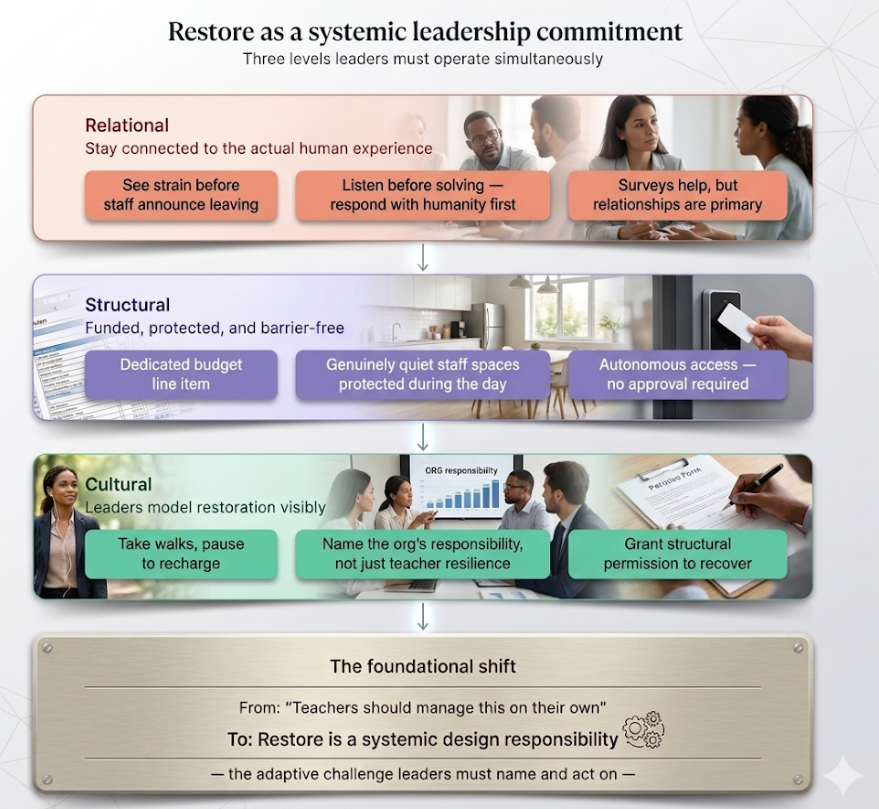
Restore — the first domain of the REEL framework — is not a static checklist or a wellness program with a new name. It is a dynamic leadership practice that looks different in every building, community, and culture. What it holds constant across all of them is this: restoration is not about eliminating the difficulties of teaching. It is about building the supported capacity to re-center in the midst of those difficulties — so that the work remains deeply meaningful rather than merely survivable. That distinction matters because it reframes what leaders are actually responsible for. Not removing the hard parts. Building the conditions that make the hard parts sustainable.
That responsibility operates at three levels simultaneously. Culturally, leaders must explicitly value and model restoration — not as a personal habit but as a visible professional norm. Structurally, they must secure and protect resources: dedicated budget line items, genuinely quiet staff spaces, and guarded time that does not quietly disappear when the calendar gets crowded. Relationally, they must stay connected to the people doing the work in ways that surveys cannot replace — close enough to see strain early and respond with humanity before it becomes a crisis.
The leader's own emotional presence is the most powerful and most underestimated resource in this work. Teachers are constantly reading the room — asking through observation rather than conversation whether it is safe to need something here. When a leader visibly pauses before a hard conversation, acknowledges openly that the work is demanding, or steps away to restore their own energy, they communicate something no policy can: that restoration is permitted here. When they don't, no program will fill that gap. This is true in ordinary years and in crisis ones — perhaps especially in crisis ones, when the instinct to push through is strongest and the cost of doing so is highest.
Noticing when restoration is absent requires a different kind of attention than managing operational flow. It means watching for the teacher who has stopped initiating, who completes every required task and yet stops volunteering, who laughs less easily than in September. These are quiet withdrawals — and they are data. Naming what is noticed is delicate. Too early and it feels like monitoring. Too late and it feels like a formality. The window is a genuine moment of human curiosity before the pattern has solidified. What follows requires restraint — staying with what is being said long enough to understand it, rather than moving immediately to solve, reassign, or reframe. Restoration as a leadership practice is not primarily about what leaders provide. It is about what they make possible by how they show up.
System & Structure Lens
Moving from the idea of restoration to a concrete strategy means embedding recovery directly into the infrastructure of the school day. We currently lack structural mechanisms to support job satisfaction before a crisis hits. Creating the space within the system to restore is the primary objective. Bloom (2013) notes that in high-stress environments, the specific method of recovery is secondary—it is creating a dedicated, predictable space and structure that is primary.
Practically speaking, this looks like a barrier-free "check-out model" where districts distribute active and passive tools across buildings for staff to borrow autonomously, rather than gatekeeping support behind an approval process. In practice, this structural commitment shows up in three tangible ways:
- The Physical Environment: Bringing nature indoors with small, living plants on desks or maximizing natural light in a quiet staff room to lower physiological tension.
- Sensory & Attentional Recovery: Keeping mindfulness tools or meditation cushions accessible in staff spaces to help educators quiet a racing mind and reset focus.
- Physical Relief: Providing ergonomic standing pads, neck massagers, or under-desk ellipticals to ease body tension right where teachers work.
Structurally funding and protecting these resources moves us away from a superficial wellness checklist. It builds a genuine practice that communicates professional respect and proves the system values their humanity.
Reflect. Connect. Grow.
Reflect. (Sense-Making and Mindset)
- Think about the "wellness" activities you’ve offered. To what degree were they individual, sporadic, and optional versus visible, funded, and systemic priorities?
- Do you still operate with an unexamined expectation that teachers should be able to manage the emotional demands of the job on their own?
Connect. (Relational Dynamics and Cultural Signals)
- When a high-performing teacher mentions leaving, do you pause and consider whether their professional experiences had become hollowed out?
- Think of a time you noticed a teacher showing signs of fatigue. Was your response a technical one, or was it an adaptive leadership stance of listening to the human experience?
Grow. (Systemic Design and Action)
- Does your budget have a dedicated, protected line item for staff retention strategies, and are there actual structural mechanisms to measure and support job satisfaction in real-time?
- Which single, tangible restoration resource could you implement tomorrow to begin a systemic shift in your building towards an environment that supports the full human being?
Looking Forward
When leaders begin to see restoration as an organizational responsibility rather than a personal one, something shifts in how they read their buildings. Any systemic approach to restoration must honestly grapple with the teacher experience and shift our lens to one of humanity first. A culture where every staff member feels genuinely seen, supported, and valued by leadership as people before professionals is the systemic certainty we must build towards.
That shift is the foundation the rest of this series builds on — a staff with genuine pathways to restoration has the capacity for what comes next: real community, and voice that shapes the institution they work in.The next entry moves into Engage and Empower. Underneath both is a belief worth examining: that community builds itself when people work alongside each other long enough, and that voice is something teachers either have or don't. The next entry will ask whether those beliefs are holding — and what a leader would need to design differently if they decided they weren't.
References
Bloom, S. L. (2013). Creating sanctuary: Toward the evolution of sane societies (Rev. ed.). Routledge.
Cavanaugh, B. (2016). Trauma-informed classrooms and schools. Beyond Behavior, 25(2), 41–46.
Heifetz, R. A., Linsky, M., & Grashow, A. (2009). The practice of adaptive leadership. Harvard Business Review Press.
Pahl, A. L. (2022). Addressing teacher attrition through trauma-informed practices in the workplace (Publication No. 714) [Doctoral dissertation, Minnesota State University Moorhead]. RED: Repository for Educational Documentation.
