
Returning to Purpose: Sustaining Yourself and Your Team Through Change
Dec 11, 2025
Purpose is one of the strongest stabilizers leaders can draw on during times of change. Beyond the poster or the branding language, it’s the deeper grounding that helps teams stay connected to why they are doing the work when change accelerates, tensions rise, or energy starts to fracture.
Research across the last decade has made one thing increasingly clear: it isn’t change that fatigues teams; it’s changing without clarity, coherence, and connection. Change without the ability to rely and call upon one another when help or support is needed. Studies examining organizational change repeatedly show that when the “why” becomes unclear or inconsistent, employee motivation and commitment deteriorate, even when the change itself is well-intentioned. Fatigue isn’t simply emotional exhaustion; it is cognitive dissonance deepening over time.
In education, where initiatives shift frequently and expectations mount quickly, this dissonance becomes a significant implementation barrier. Yet returning to purpose, anchoring decision-making in shared values, and clarifying the next right step, acts as a psychological and operational steadying force.
Purpose as an Implementation Stabilizer
Recent findings on change engagement reinforce this: teams remain committed when organizational and job resources are aligned. This means resources must be perceived to be delivered with clarity, high levels of communication, honoring the shared vision, and having clearly delineated leadership support steps. When these conditions are present, both implementation levels and intrinsic motivation increase. When they are absent, change-fatigue grows, even in teams operating at higher levels of teaming development (Aguilar, 2025).
A 2025 study exploring the Energy-Commitment Model found that change-fatigue is not just about workload but about a progressive depletion of meaning: a slow erosion of the sense that one’s work is connected to something coherent or worthwhile. That is exactly why returning to purpose matters: it replenishes meaning.
- This isn’t optimism.
- This isn’t morale boosting.
- This is the direction.
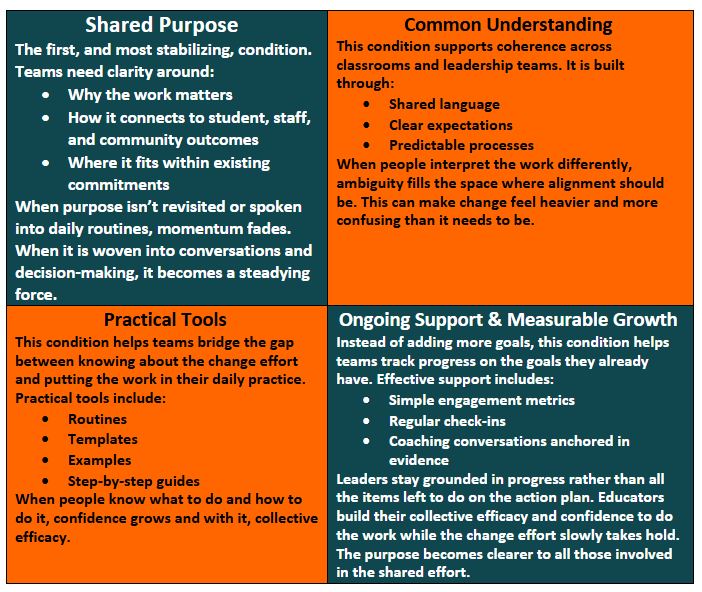
In the Making Champions of Change model, four core conditions determine whether implementation gains traction or stalls: Shared Purpose, Common Understanding, Practical Tools, and Ongoing Support for Measurable Growth. These conditions appear consistently in districts across the country and help explain why even excellent professional learning doesn’t automatically translate into day-to-day practice.
Why Purpose Is the Anchor
These four conditions reinforce one another, but purpose is the anchor that keeps them aligned and meaningful. When frustration and fatigue surface, as they inevitably do during complex change, teams typically face two choices:
- Name what’s getting in the way, or
- Hold it in until commitment erodes
This crossroads shows up in real, observable ways:
- People stop asking questions about what they think they “should already know”
- Meetings become quieter, with fewer contributions
- Teams complete tasks but lose ownership
- Data shows stagnation, but no one wants to be the one to raise it
Leaders Influence Which Path Teams Choose
Leaders who create conditions for honest dialogue help teams choose the healthier path. They:
- Model naming barriers early, without shame or blame
- Use data to illuminate what’s emerging (“The fidelity dip here tells us something is getting in the way…”)
- Bring research into the room to expand what’s possible
- Re-center decisions on shared purpose (“This matters because…”)
- Normalize the human side of implementation (“This is hard, and here’s why it still matters…”)
This approach shifts frustration from something people hide into something the team can act on.
Purpose as Protection
When teams reconnect to a shared purpose, not just a statement on a poster but a set of lived beliefs, leaders:
- Strengthen team efficacy
- Reduce the emotional toll of implementation
- Protect staff and student well-being
- Create coherence in seasons of change
Purpose becomes not just a message leaders communicate, but a shield of teams can rely on when complexity rises.
What Returning to Purpose Looks Like in Real Teams
Leaders often ask: “But what does it look like to actually do this?” Returning to purpose is not a one-time activity. It’s a rhythm.
Begin with the value, not the task: Before diving into an agenda item or change in the system, ask: “Which of our values, norms, or collective commitments should guide this conversation?”
Teams create norms with one another to guide the way they show up in tough conversations. Call upon them when tough conversations are on the horizon. This prepares the team and reduces decision fatigue and refocusing teams on identity rather than urgency.
Narrate the why every time the what changes: Inconsistent communication is a key predictor of change cynicism (Reactions Toward Organizational Change, 2022). A 20-second explanation can prevent a 20-day morale slide. This is not about assuming the educators don't know! This is about honoring them in the work they are already doing day in and day out, providing them with the tools that they need to know explicitly what is expected of them to be successful in the shift, and following up with fidelity checks to determine how best to support those who need additional resources for implementation.
Slow the pace when clarity drops: Research shows that rapid unplanned or undocumented change efforts increase psychological strain and reduce organizational commitment (Kapping, M., 2021). Slowing is an act of leadership courage. Use purpose to make-meaning, organize, and sequence; do not just justify the work. Purpose helps teams decide what is essential now versus what is essential later.
Name the strain honestly: Purpose without honesty breeds toxic positivity. Honesty without purpose breeds stagnation. Teams need both. Leadership coaching texts like Jenkins’ Connectable reinforce the idea that belonging and psychological safety deepen when leaders create space for honest emotional acknowledgment, especially during times of transition.
This idea was shared in the last implementation series: “Showing up with gratitude means recognizing both visible successes and unseen effort. It means valuing the courage it takes for educators to name challenges, question systems, or share a concern. True gratitude, then, is not only about celebrating what is going well, but also about honoring those who trust us enough to name what is not.” If culture in your system is an idea you need to explore, read more here.
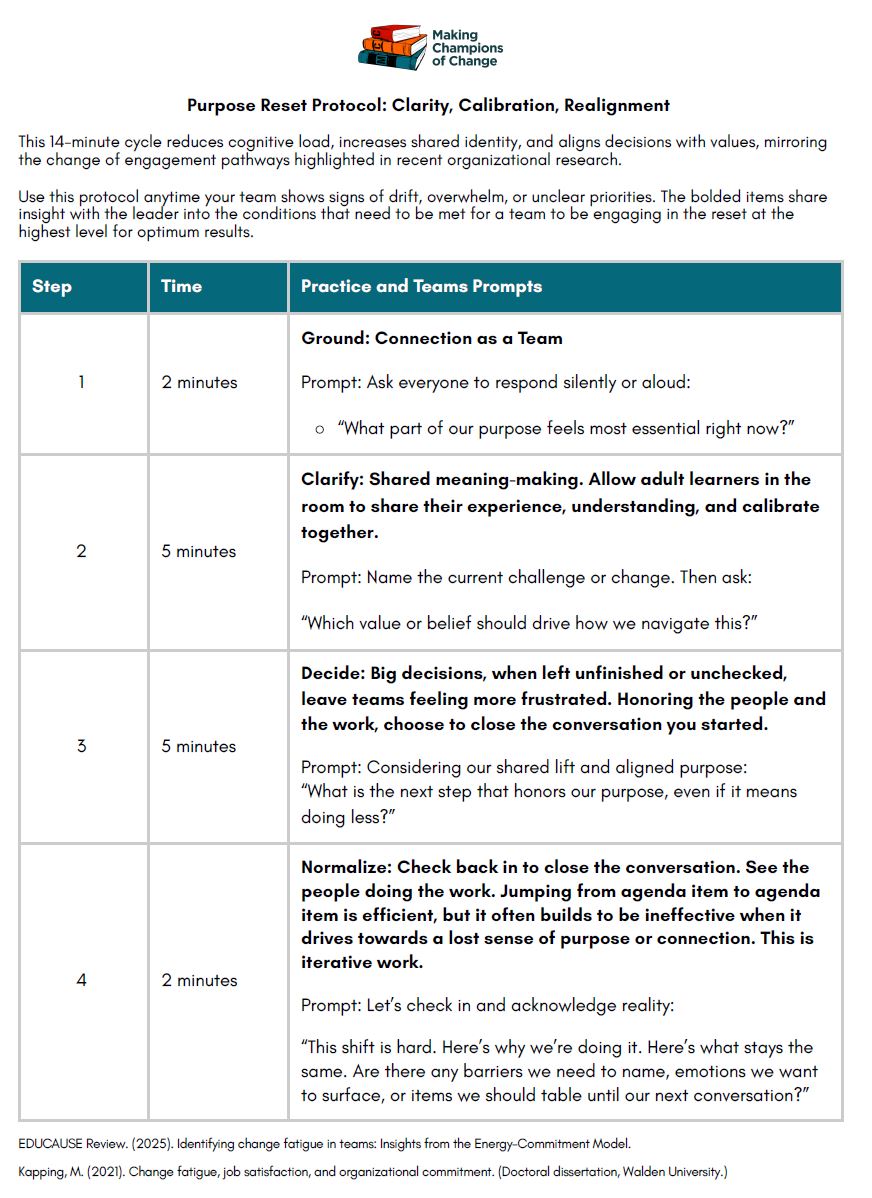
Purpose Reset Protocol: Clarity, Calibration, Realignment
This 14-minute cycle reduces cognitive load, increases shared identity, and aligns decisions with values, mirroring the change of engagement pathways highlighted in recent organizational research. Use this protocol anytime your team shows signs of drift, overwhelm, or unclear priorities. The bolded items share insight with the leader into the conditions that need to be met for a team to be engaging in the reset at the highest level for optimum results. To download this tool and use it with your team to reflect together, click here.
Returning to Purpose is Honest Work
Leaders don’t need to convince teams that everything is fine. They need to create coherence. Clear purpose doesn’t eliminate complexity, but it gives complexity a place to land. Every time a team returns to purpose, it reinforces one message: We are not moving aimlessly. We are moving meaningfully.
Each conversation is an opportunity to build connection, lead with humility and curiosity, and determine how to ground in purpose together. As a leader, continue to celebrate each moment an educator brings a conversation with “just another problem” to you. This is when the meaning-making and calibration around the purpose happen. The barriers of our system exist. Stay humble, those educators trust their team or their leader enough to believe that the change effort was worth trying and was bringing back initial results (although usually anecdotal at this point). Take the feedback even if it's negatively delivered in those moments, process alongside them, and help realign to the shared purpose.
Closing Reflection
Returning to purpose doesn’t eliminate the complexity of change; it gives the complexity a place to land. Anchored teams aren’t teams without challenges; they’re teams with coherence.
- Purpose stabilizes systems, practices, and emotions.
- Purpose sustains connection, implementation, and efficiency.
- Purpose protects people, collective efficacy, and commitment to change.
References
EDUCAUSE Review. (2025). Identifying change fatigue in teams: Insights from the Energy-Commitment Model.
Nie, D., Li, X., Wang, Y., & Xu, H. (2025). Employees’ perception of digital human resource management practices and intrinsic motivation amid organizational change. Frontiers in Psychology.
Vullinghs, J., De Jong, J., & Schaufeli, W. (2022). The influence of change-related organizational and job resources on change engagement. Journal of Organizational Psychology.
Kotter, J. P. (2012). Leading Change. Harvard Business Review Press.
Kouzes, J. M., & Posner, B. Z. (2017). The Leadership Challenge (6th ed.). Wiley.
Jenkins, R., & Jenks, S. (2022). Connectable: How Leaders Can Move Teams from Isolated to All. McGraw-Hill.
Kapping, M. (2021). Change fatigue, job satisfaction, and organizational commitment.
(Doctoral dissertation, Walden University.)
