
May 2026 Series: The Work Between Us (Entry 2: Structures That Support Collaboration)
May 14, 2026
Structures That Support Collaboration
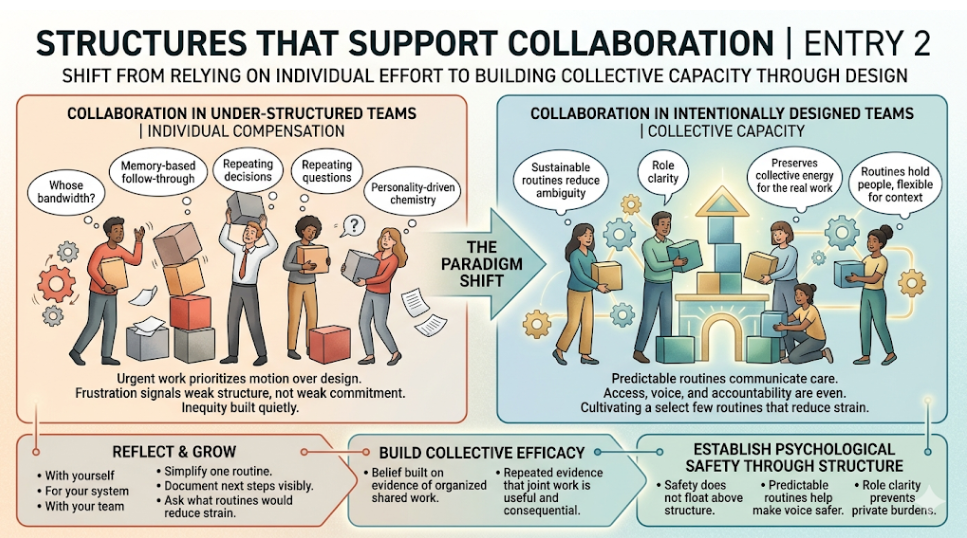
When collaboration is under-structured, people compensate. When it is intentionally designed, teams can actually share the work.
By Dr. Morgan Goering and Dr. Amy Pahl
Estimated read time: ~8-10 minutes
Many teams do not fail collaboration because they lack care. They fail it because care is being asked to carry what structure should have held. The team likes each other, the meeting starts on time, and the agenda exists, and yet, the work feels heavier than it should. Questions repeat, decisions get revisited, and follow-through depends on memory, energy, or whoever has the most bandwidth that week.
This is the point where leaders often turn to personality explanations: some people are organized, and others are not; some teams are naturally collaborative, while others are harder to move. The personality storyline is usually too narrow because collaboration is far more shaped by design than by chemistry. Teams experience trust, belonging, and momentum differently when the work is held by clear routines rather than by individual compensation.
Collaboration in Practice
Research on teamwork and school improvement supports this design lens. Salas et al. (2005) argue that effective teamwork rests on identifiable processes rather than general positivity. Teams perform better when they have clear coordination, shared monitoring, backup behavior, and adaptability. In schools, Goddard, Hoy, and Woolfolk Hoy (2000) found that collective teacher efficacy is associated with student achievement, reinforcing the idea that belief in joint capability matters. However, that belief does not emerge from slogans; it is built when teams have repeated evidence that their shared work is organized, usable, and consequential.
Psychological safety is a critical component of the structure. Edmondson (1999) demonstrated that teams are more likely to engage in learning behaviors when they believe the group is safe for interpersonal risk-taking. Importantly, safety does not float above structure. Predictable routines help make voice safer, role clarity helps make disagreement less personal, and feedback loops keep problems from becoming private burdens. Structure, in this sense, is not the opposite of belonging; it is one of the primary conditions that make belonging possible.
This becomes visible in schools quickly. Teams collaborate differently when they know the purpose of a meeting, how decisions will be made, what will be documented, and how unfinished items will return. These routines do not make collaboration mechanical; instead, such designs ensure the work remains usable. Clear structures reduce friction, protect time, and prevent collective efforts from collapsing into repeated conversations without movement.
Leadership and Facilitation Practice
One internal reflection from this year described a team that had spent months moving quickly through launch work. The pathways were finally up and running, but when the pace eased enough to look inward, a revealing truth surfaced: the team could not easily name its own norms, its internal goals, or the clearest picture of its shared infrastructure. The issue was not a lack of commitment. The issue was that the system had been running on motion longer than it had been running on design.
Moments such as these are deeply familiar in schools. Structures are often treated as secondary because urgent work feels more important than internal architecture. Over time, however, the absence of structure becomes its own drain. Leaders then have to recreate expectations midstream, repair misunderstandings after the fact, and rely on stronger personalities to interpret what should have been explicit from the start.
Leadership changes this scenario by recognizing that collaboration is an adaptive challenge, not just a technical task. It requires more than a shared calendar; it requires the discipline to treat structure as a form of care. In practice, that means protecting meeting cadence, clarifying the meeting type, naming roles before confusion appears, and documenting next steps visibly. Leading through collaboration challenges requires balanced adaptive leadership to avoid the technical trap of over-engineering. The goal is not to introduce a fresh protocol for every obstacle, but to cultivate a select few sustainable routines that reduce ambiguity, increase follow-through, and preserve the team's collective energy for the actual collaborative work.
System and Structure Lens
Systems communicate what matters by making what is predictable. If collaboration relies on improvisation every time, then access, voice, and accountability will be uneven. Some people will naturally enter while others wait to be invited; some will know how a decision becomes action, while others do not. In those environments, inequity is often built quietly through process rather than loudly through conflict.
This is where belonging and collective efficacy braid together. Belonging grows when people know how to participate without guessing, and collective efficacy grows when teams repeatedly see that their shared work can move something real. Both are strengthened by routines that are clear enough to hold people and flexible enough to honor context.
For leaders, the challenge is not to build more structure than the system can carry, but to build enough structure that collaboration no longer depends on over-functioning or the emotional tax on those with the most relational stamina. Rather than question how to make the team more collaborative, ask what routines would reduce strain, increase clarity, and help this team trust its own shared capacity.
Reflect. Connect. Grow.
Read more about the Reflect. Connect. Grow. Adult Learning Design Framework here.
With yourself
- Reflect: Where do I assume people know the routine when it has never been made explicit?
- Connect: When are frustrations I feel most often actually signals of weak structure rather than weak commitment?
- Grow: What one routine could I simplify, stabilize, or revisit before our next collaboration cycle?
For your system
- Reflect: Where does collaboration in our system depend too much on memory, goodwill, or a few strong people?
- Connect: How do unclear roles or inconsistent meeting design shape voice, follow-through, and trust?
- Grow: What one predictable structure would reduce confusion and hidden labor without increasing external control?
With your system
- Reflect: What parts of our collaboration feel clear, and what still feels improvised?
- Connect: Where are we seeing repeated friction that points to a design issue rather than a people issue?
- Grow: What routine, role clarification, or feedback loop would help this group collaborate more authentically?
Looking Forward
Once the structure is strong enough to hold the work, the next question becomes relational and political: how do leaders hold a room so people actually enter it? The next entry turns to listening and facilitation as acts of leadership, influence, and equity.
References
Edmondson, A. C. (1999). Psychological safety and learning behavior in work teams. Administrative Science Quarterly, 44(2), 350-383. https://doi.org/10.2307/2666999
Goddard, R. D., Hoy, W. K., & Woolfolk Hoy, A. (2000). Collective teacher efficacy: Its meaning, measure, and impact on student achievement. American Educational Research Journal, 37(2), 479-507. https://doi.org/10.3102/00028312037002479
Ronfeldt, M., Farmer, S. O., McQueen, K., & Grissom, J. A. (2015). Teacher collaboration in instructional teams and student achievement. American Educational Research Journal, 52(3), 475-514. https://doi.org/10.3102/0002831215585562
Salas, E., Sims, D. E., & Burke, C. S. (2005). Is there a 'Big Five' in teamwork? Small Group Research, 36(5), 555-599. https://doi.org/10.1177/1046496405277134
