
July Series 2026: Connection First (Entry 5: Sustainability Is Designed from the Beginning)
Jul 30, 2026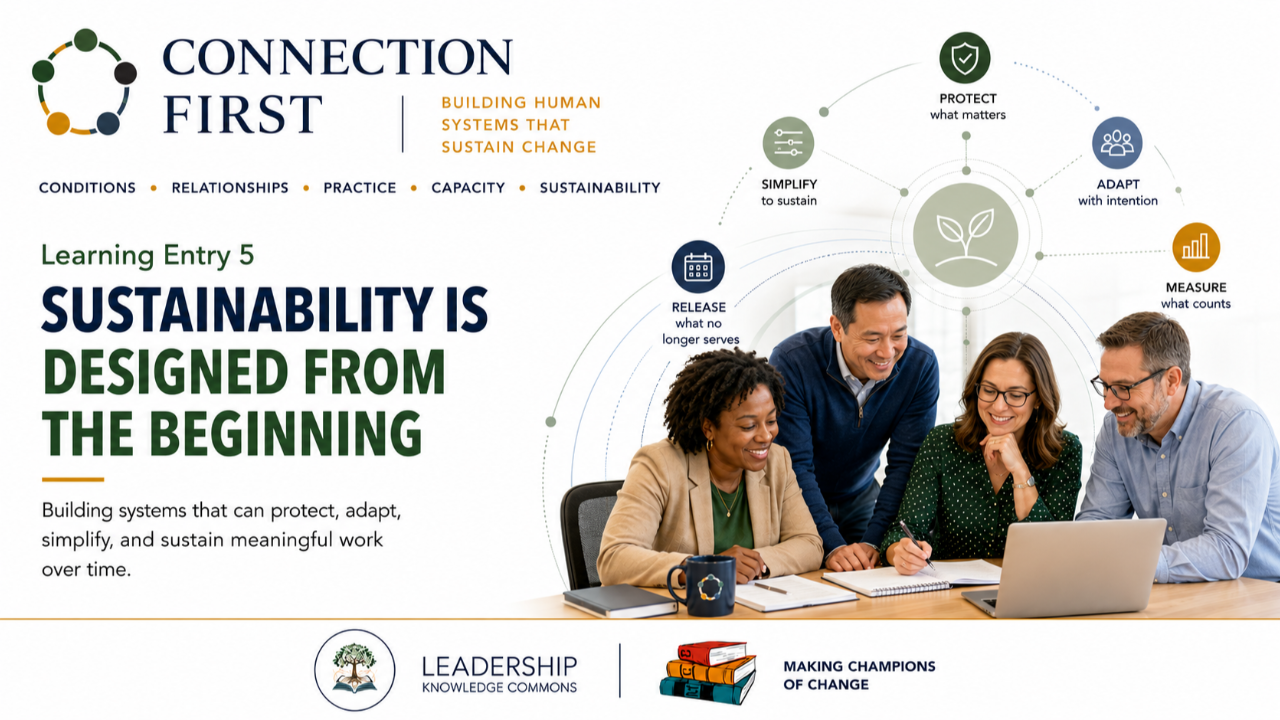
Sustainability Is Designed from the Beginning
Coherence, Infrastructure, Adaptation, Measurement, and Systems That Last
Connection First Series — Sustainability By Janine Gacke
Estimated read time: ~7 minutes
Opening Frame
By this point in the series, the pattern is clear: meaningful implementation does not begin with a stronger reminder, a tighter checklist, or one more meeting. It begins beneath the strategy. Conditions shape whether people can engage honestly. Relationships hold the complexity. Practice makes purpose visible. Capacity helps people carry the work with knowledge, skill, time, support, and confidence. Sustainability brings all of that together.
But sustainability asks a different kind of question. Will the work last when the launch energy fades, when the original champion moves into a new role, when new staff join, when funding changes or another priority arrives — when people are no longer being reminded by the person who first introduced it?
Sustainability is often treated as something leaders consider at the end: after the training, after the pilot, after people have worked hard enough to prove the effort is worth keeping. But by then, the system may already be carrying the work in a fragile way. Sustainability is not what happens after implementation. It is designed into implementation from the beginning.
Sustainability Is Dynamic, and the Work Must Become System-Held
Sustainability is not a finish line. It is the ongoing work of keeping something useful, visible, supported, and beneficial as conditions change — continued delivery, maintained practice, and sensible adaptation over time (Moore et al., 2017). That shifts the leadership question from "Have we sustained this yet?" to "What does this work need now to keep producing value?" A linear, implement-and-forget view quietly creates fragility: meetings thin out, data is reviewed less often, attention moves on — and then turnover or a new priority begins to weaken the work.
Good work becomes fragile when it lives in the wrong place. It may live in one person's head, in a folder no one opens, in a training that happened once, or in a team's enthusiasm but not the calendar. At first the fragility is hard to see, because a strong leader keeps it moving, a skilled coach fills the gaps, a committed teacher reminds the team. Then the coach is reassigned, the principal leaves, planning time disappears — and the work that seemed stable begins to drift. That drift is rarely evidence that people stopped caring. More often, the work was never fully held by the system (Fixsen et al., 2005; Wiltsey Stirman et al., 2012).
This is the central move of the domain: work has to travel from people-held to system-held. People always begin the work — someone sees a need, learns a practice, builds the first version of the routine. The risk comes when it stays people-held too long, dependent on individual memory, skill, and availability. System-held work is carried by routines, roles, calendars, documentation, decision rights, coaching, and shared ownership. A behavior system that rests on one dean is people-held; the same system with shared routines, common language, and data structures is becoming system-held. The goal is not to remove people from the work. It is to stop asking individuals to be the only structure holding it — which is what connection as infrastructure finally means at the scale of a system.
Leadership Practice in the Moment
Sustainability is built through practical moves that make the work easier to keep carrying. A principal notices a student-support routine works when the original team is present but breaks down with substitutes or new staff; instead of reminding everyone again, she has the team make a one-page routine map, adds it to onboarding, and practices it at a staff meeting. A leadership team realizes a monthly meeting has become a reporting space rather than an improvement routine, so rather than cancel it or add another, they redesign the agenda around three questions: what are we seeing, what are we learning, and what needs to be adjusted? We’ve created a quick one-page resource for you to gather your thoughts and guide you through answering these questions.
These moves are not flashy. They move the work from memory into routine, from individual effort into shared ownership, and from activity into learning. And sustainability sometimes requires the opposite of adding — it requires saying no, not yet, or not anymore. Most ideas in schools are attached to real needs, so the question is not only whether the work is good, but whether the system can carry it well without weakening what already matters most. A full system cannot sustain unlimited priorities. Leaders protect sustainability when they ask what will be removed, simplified, or integrated before they add more. This is not negativity; it is protecting coherence — choosing depth over accumulation.
System & Structure Lens
A system designed for sustainability does not wait until the end to ask how the work will last. It asks from the beginning: Where will this live? Who will own it? How will new people learn it? What time will be protected? How will drift be noticed early? What will be stopped so this can be done well? These are not end-of-year maintenance questions; they are beginning-of-implementation design questions, and they are where the infrastructure to sustain a practice is actually built (Fixsen et al., 2005; Watkins, 2025). Sustainability problems tend to surface late but are created early — a practice fades in October because planning time was never protected in August (Peretz, 2025).
Two kinds of information keep that infrastructure honest. Capacity data show whether the system has the structures — leadership, teaming, coaching, data use, communication — to keep supporting a practice. Fidelity data show whether the practice is still being used as intended. Activity is not the same as integrity: a team still meeting or a tool still in use does not, by itself, mean the work is being carried well.
Sustainable systems also make adaptation intentional rather than quiet, protecting the core of a practice while letting the details flex to fit context, so drift becomes shared learning instead of a hallway workaround (Durlak et al., 2008). Sustainability becomes far more likely when the work is embedded in ordinary structures — onboarding, team agendas, coaching cycles, data routines, budget conversations, leadership transitions — rather than depending on one annual training or one person's memory. Improvement science shows that systems get better by learning from variation and building routines that help people improve together over time (Bryk et al., 2015); sustainability is not the finish line after improvement, but the design work that lets improvement continue.
Companion Tool: The Sustainability Design Compass
To make this concrete, the companion tool — The Sustainability Design Compass — helps a team examine whether one priority is designed to last beyond its launch by looking in four directions:
Purpose: Why does this work matter, and is that purpose still clear?
Infrastructure: Where does the work live in routines, roles, calendars, tools, communication, and protected time?
People: Who carries the work, who is learning it, and how is ownership distributed beyond one person?
Evidence: What capacity and fidelity data help us know whether the work is being supported, implemented, adapted, and sustained?
It is not meant to produce a perfect plan — only to help leaders notice what direction the system needs next.
Reflect. Connect. Grow.
Reflect. Where might your system be treating sustainability as a finish line rather than an ongoing process of learning, adapting, and protecting what matters?
Connect. Where do capacity, fidelity, turnover, or competing priorities reveal that important work may still be fragile?
Grow. What is one move you could make this month to move a piece of work from people-held to system-held — strengthening infrastructure, measurement, or shared ownership?
Looking Back Across the Series
Connection First began with conditions, because people cannot carry meaningful work well inside unclear, unsafe, or overloaded systems. It moved into relationships, because implementation depends on trust, communication, repair, and shared ownership. It moved into practice, because purpose becomes visible only when it can be seen, taught, and repeated. Capacity showed that people may be willing and still need knowledge, skill, time, support, and confidence to follow through. And sustainability brings those domains together — because the through-line of the whole series has been a single idea: meaningful change is carried by the human system beneath the strategy, not by any one person holding it up.
Conditions create the environment. Relationships hold the complexity. Practice makes purpose visible. Capacity helps people keep going. Sustainability helps the system last.
Sustainable change begins beneath the strategy.
References
Bryk, A. S., Gomez, L. M., Grunow, A., & LeMahieu, P. G. (2015). Learning to improve: How America's schools can get better at getting better. Harvard Education Press.
Durlak, J. A., DuPre, E. P., & DuBois, D. L. (2008). Implementation matters: A review of research on the influence of implementation on program outcomes and the factors affecting implementation. American Journal of Community Psychology, 41(3–4), 327–350.
Fixsen, D. L., Naoom, S. F., Blase, K. A., Friedman, R. M., & Wallace, F. (2005). Implementation research: A synthesis of the literature. University of South Florida, Louis de la Parte Florida Mental Health Institute, National Implementation Research Network.
Moore, J. E., Mascarenhas, A., Bain, J., & Straus, S. E. (2017). Developing a comprehensive definition of sustainability. Implementation Science, 12, Article 110.
Peretz, R. (2025). Integrating systems thinking into sustainability education: An overview with educator-focused guidance. Education Sciences, 15(12), 1685.
Watkins, C. (2025). Long-term implementation part II: Sustaining implementation through active implementation. National Implementation Research Network / SISEP Center.
Wiltsey Stirman, S., Kimberly, J., Cook, N., Calloway, A., Castro, F., & Charns, M. (2012). The sustainability of new programs and innovations: A review of the empirical literature and recommendations for future research. Implementation Science, 7, Article 17.
