
May 2026 Series: The Work Between Us (Entry 3: The Facilitator's Mindset)
May 21, 2026
The Facilitator's Mindset: Listening as Leadership
Listening is not passive. It is one of the ways leaders shape power, trust, and what becomes sayable in a room.
By Dr. Morgan Goering and Dr. Amy Pahl
Estimated read time: ~8-10 minutes
Most collaborative rooms do not fail because people have nothing to say. They fail because the room is not being held in a way that makes speaking worth the risk. Leaders ask good questions, invite input, and leave time on the agenda for discussion. But the conversation still stays polite, surface-level, or strangely narrow. The problem is often misread as disengagement when it may actually be a more accurate read of the conditions.
This is where listening needs to be reframed. In schools, listening is often treated as courtesy or temperament - something good leaders do because it is respectful. While that is true, it is incomplete. Listening is also a leadership act, one that shapes what information enters the room, whose meaning counts, and whether collaboration becomes a space for compliance, performance, or shared sense-making.
Collaboration in Practice
The research on listening at work is clearer than many leadership conversations suggest. Kluger and Itzchakov (2022) review evidence that listening has meaningful effects on relational, cognitive, and organizational outcomes for both speakers and listeners. Listening is not passive reception; it is an active, dyadic process that changes what becomes possible in a conversation. Jonsdottir and Kristinsson (2020) similarly found that supervisors' active-empathetic listening was positively related to employee work engagement, suggesting that how leaders listen affects whether people remain open and invested in the work.
Leader-humility research adds another layer to this dynamic. Owens and Hekman (2012) describe humble leader behaviors as including an accurate view of self, appreciation of others' strengths, and teachability. These are not merely personality markers; they are power moves that change whether leadership feels like a fixed answer entering the room or like an invitation into shared sense-making. In psychologically safe environments, people are more willing to admit uncertainty, surface concerns, and test ideas aloud (Edmondson, 1999). Listening helps create that environment when it communicates that speaking will not simply be managed or neutralized.
For schools, this means listening must be understood as part of facilitation, not as a personal virtue alone. The facilitator who listens well is not simply quiet; they are making judgments in real time about pacing, uptake, silence, who has entered, whose comment changed the room, and whether the conversation is moving toward truth or toward self-protection.
Leadership and Facilitation Practice
Morgan's leadership arc offers a useful illustration. Across district roles, consulting work, and the Leadership Knowledge Commons, one insight kept surfacing: when leaders tell their stories, they reveal their systems. Their narratives carry assumptions, constraints, hopes, and quiet places of strain. Listening closely, therefore, changes the work. The task is no longer just to provide a faster answer, but to hear what the system is saying through the people speaking from within it.
That kind of listening requires restraint. It asks leaders to pause before solving, to paraphrase before redirecting, and to notice whether a room is producing real information or only safe responses. It asks facilitators to hear not only what is spoken but what has not yet been made sayable. In practice, facilitators begin asking fewer questions and staying with them longer, inviting others to build on what has been said before moving on, or naming patterns in the conversation without imposing a single interpretation.
Good facilitation also redistributes power. When leaders listen only for what confirms the path they already prefer, participation becomes theater. When leaders listen in a way that changes what can happen next, participation becomes consequential. This is one of the deepest forms of leadership restraint: letting listening alter the design of the work rather than merely decorate it.
System and Structure Lens
Listening is often discussed as though it lives entirely inside the individual leader, but systems teach listening, too. They teach it through how meetings are facilitated, whether comments are documented, whether dissent is revisited, whether questions receive an answer later, and whether some voices predictably disappear without consequence. A school can say it values voice while training people not to use it.
For this reason, facilitation should be treated as infrastructure. A well-held room has visible practices that make listening real: clear purposes, thoughtful pacing, invitation patterns, note capture, response loops, and norms for how ideas are taken up. Without those elements, leaders may genuinely listen in the moment while the system itself remains unlistening over time.
The larger leadership question is not simply, 'Am I a good listener?' It is, 'What does my facilitation teach people about the risk and usefulness of speaking here?' When leaders ask that question honestly, listening stops being an interpersonal nicety and starts becoming a core part of how collaboration is designed.
Reflect. Connect. Grow.
Read more about the Reflect. Connect. Grow. Adult Learning Design Framework here.
With yourself
- Reflect: What do I tend to do when a room gets quiet, uncertain, or emotionally loaded?
- Connect: Whose voice do I take up most quickly, and whose voice do I unintentionally leave at the edges?
- Grow: What is one facilitation move that would help me listen in a way that changes the room rather than manages it?
For your system
- Reflect: What has the system taught about the usefulness of speaking honestly?
- Connect: Where do ideas get surfaced but not meaningfully taken up, answered, or revisited?
- Grow: What is one meeting or feedback-loop adjustment would make voice more consequential here?
With your system
- Reflect: When do our conversations feel most real, and when do they become cautious?
- Connect: What patterns are we noticing about who enters, who hesitates, and whose ideas travel?
- Grow: What listening norm, response loop, or facilitation practice should we strengthen together to increase our shared capacity?
Looking Forward
If listening changes who can enter a collaborative space, then the final question of the month is relational and moral: what helps people stay willing to remain in that space after strain, misunderstanding, or past harm? The final entry turns to collaboration as a belonging practice.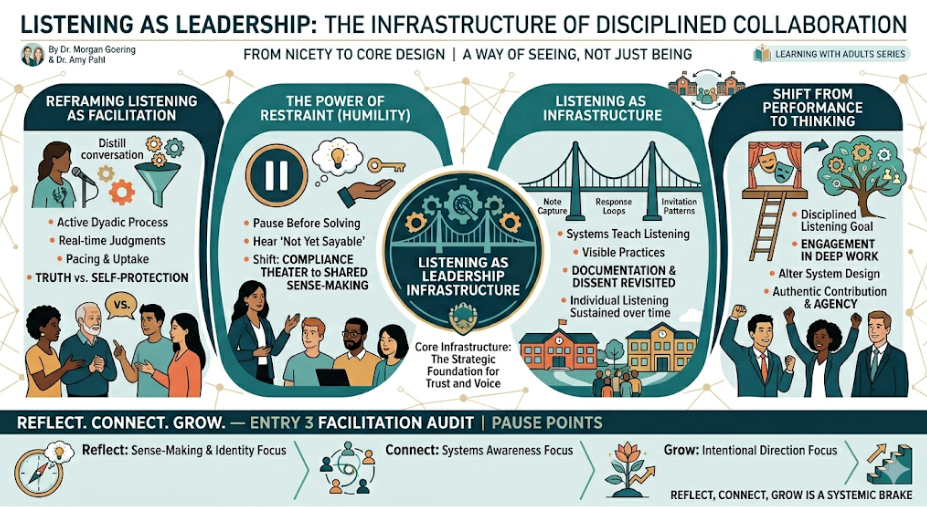
References
- Edmondson, A. C. (1999). Psychological safety and learning behavior in work teams. Administrative Science Quarterly, 44(2), 350-383. https://doi.org/10.2307/2666999
- Jonsdottir, I. J., & Kristinsson, K. (2020). Supervisors' active-empathetic listening as an important antecedent of work engagement. International Journal of Environmental Research and Public Health, 17(21), Article 7976. https://doi.org/10.3390/ijerph17217976
- Kluger, A. N., & Itzchakov, G. (2022). The power of listening at work. Annual Review of Organizational Psychology and Organizational Behavior, 9, 121-146. https://doi.org/10.1146/annurev-orgpsych-012420-091013
- Owens, B. P., & Hekman, D. R. (2012). Modeling how to grow: An inductive examination of humble leader behaviors, contingencies, and outcomes. Academy of Management Journal, 55(4), 787-818. https://doi.org/10.5465/amj.2010.0441
