August 2026 Learning Series: Beyond the Triangle (Entry 2 - Tier 1: The Culture Every Student Feels First)
Aug 13, 2026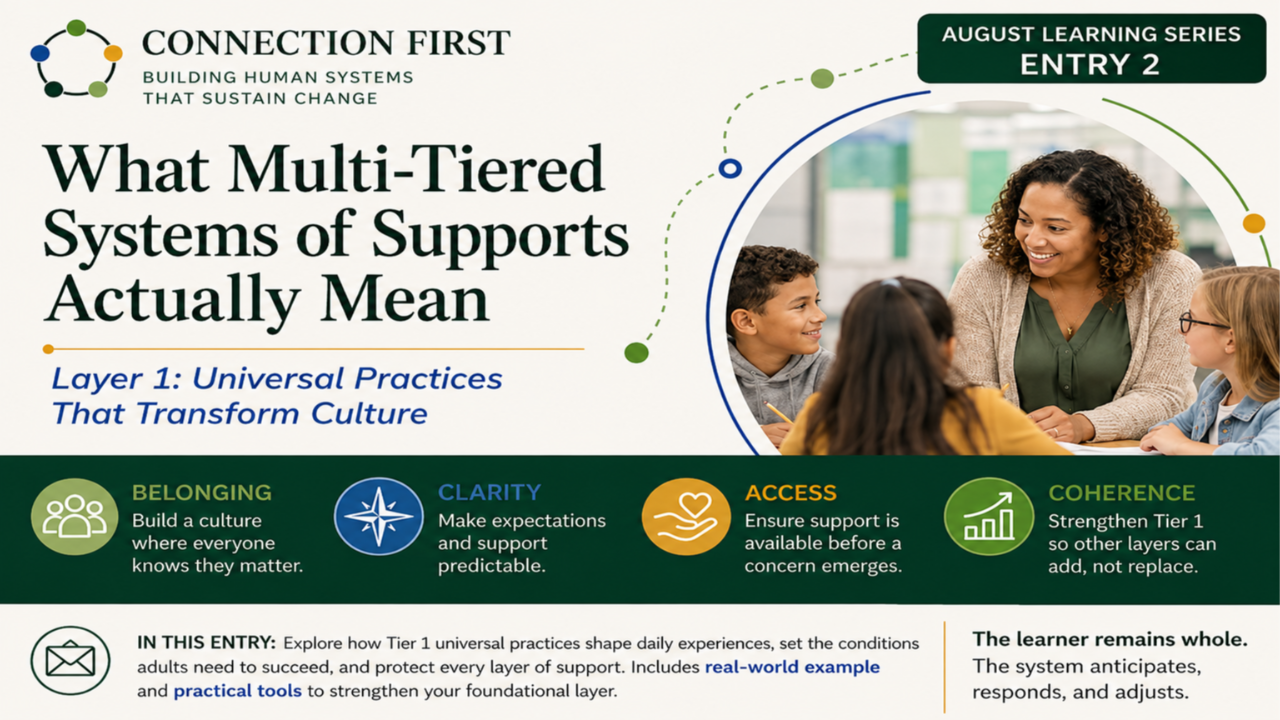
Tier 1: The Culture Every Student Feels First
August Learning Series: Beyond the Triangle - Entry 2
By: Janine Gacke, Ed.S. and Megan Garbe
Estimated read time: ~8-10 minutes
Support Should Add, Not Replace
Every day, students learn two curricula. One is written. The other is invisible.
Students learn which classrooms feel predictable and which expectations remain steady. They learn where mistakes are safe to make, where questions are welcomed, and where the rules quietly change depending on who is in the room.
Adults learn an invisible curriculum, too. Staff learn which initiatives will still matter next semester, which expectations are likely to shift, and which practices are truly protected.
Learning the invisible curriculum extends to families and new staff as well.
Picture a sixth grader—call her Sophee—moving through a typical morning. First period begins with a greeting and a calm, familiar routine. In the second period, directions begin while students are still entering. Sophee misses part of the explanation and looks around to decide whether asking again is worth the risk. Third period values collaboration, but participation expectations shift with the activity. By lunch, Sophee is navigating another set of expectations in the hallway.
Each of these adults may be thoughtful, skilled, and deeply invested in their students. They bring their own strengths, approaches, and ways of creating a learning environment. And as Sophee moves from one classroom to the next, she is doing more than learning content. Some of her attention is devoted to the learning itself, while some is spent figuring out the system around it—reading expectations, adjusting to different routines, and making sense of rules that may not always be clear or consistent. The more energy Sophee spends navigating the environment, the less she has available for the learning in front of her.
Some students answer these questions quickly and invisibly. Others hesitate, withdraw, ask again, or wait for someone else to move first. Eventually, those responses may be described as disengagement, poor preparation, or difficulty with self-regulation.
Before the system names a concern within the learner, Tier 1 asks a different question:
How much predictability, clarity, and relational consistency did this learner experience across the day?
In Entry 1, we moved the tier away from the learner and back to the support. The learner remains whole. The system adjusts. That shift changes how we understand the universal layer. Tier 1 is the culture students and adults experience every day.
When Universal Isn't Experienced as Supportive
Universal doesn't mean a practice is written in the handbook. It means what people can reliably access and experience. The Center on PBIS describes Tier 1 as the systems, data, and practices that support students and staff across every school setting — a proactive foundation, not something schools wait to build until concerns intensify (Center on PBIS, n.d.).
The gap between what a school has established and what people consistently experience is where this entry lives. A school may share expectations that get reinterpreted room to room. A district may name relationship-building as a priority while some staff get coaching and others get a handout. A team may agree students should know how to ask for help while the response to asking varies by adult, time of day, or need.
In each case, the practice exists in intention and is less visible in experience. People compensate for the gap: students learn to read each room, veteran teachers build informal workarounds, new staff lean on colleagues to explain what was never written down, families learn which person actually answers. Much of this reflects real care and skill. But when individual adults have to continually compensate for gaps in universal design, care becomes dependent on proximity — strongest for whoever happens to be near an adult with the time and authority to respond.
What sounds like: This student needs more help may carry another question underneath it.
Do I have the clarity, support, and confidence to know what to do next?
Inconsistency is not always evidence that adults do not care. Sometimes it tells us the system has asked people to implement more than it has helped them learn, practice, and sustain. PBIS identifies professional development, coaching, leadership teams, and data use among the systems supporting Tier 1 implementation (Center on PBIS, n.d.). Research on sustainability similarly points to administrator support, team functioning, staff support, and integration into typical practice as important conditions (McIntosh et al., 2014).
A strong universal system does not depend on individual adults continually compensating for what the organization has not made dependable. When the system does not carry the practice, people carry it.
Leadership & Design Lens — Care Through Predictability
Predictability is sometimes mistaken for control — sameness, strictness, a way of removing professional judgment. It isn't. A predictable system doesn't require every classroom to look identical; it makes the purpose and experience of important practices recognizable across settings. It helps people know what matters here, what to expect from adults, and what to do when something goes wrong — which frees attention for learning, relationships, and problem solving instead of decoding hidden rules.
Predictability does not mean uniformity. A coherent universal layer holds shared anchors and room for responsiveness at the same time. Consistency without that room becomes rigidity — a practice applied evenly that still lands as inaccessible or harmful. Flexibility without shared anchors becomes unpredictability — support that depends on who's in the room.
This is why Tier 1 is relational as much as procedural. A clear routine matters, but so does how students are welcomed into it. A shared expectation matters, but so does whether it was taught, not assumed. Students experience care when adults follow through — when transitions are prepared rather than improvised, and support stays available after a hard moment.
Adults experience something similar. Educators sustain universal practices when leaders clarify priorities, model examples, protect collaboration time, and respond to implementation struggles with curiosity rather than compliance monitoring. Research on schoolwide implementation consistently names leadership, team functioning, staff involvement, and implementation assistance as the conditions that determine whether supports hold (McIntosh et al., 2014).
Framed this way, the leadership question shifts. Instead of asking whether teachers are using the practice, it asks whether the practice was defined clearly enough to use, whether staff saw it modeled, and whether the schedule and staffing actually support it. Where it lands differently across settings becomes useful information about the design, not a problem to correct. These questions share responsibility across the system: leaders hold the conditions, teams read the patterns, educators adapt within a clear purpose, and students and families carry knowledge about how the practice is actually experienced.
The goal is neither identical practice nor unlimited variation. The goal is aligned experience.
There is a difference between saying a universal practice exists and knowing people can reliably experience it. Use the companion From Intention to Experience: A Tier 1 Leadership Coherence Review to examine one universal experience, locate where intention and experience separate, identify who is carrying the strain, and choose one leadership move to strengthen coherence without requiring sameness.
System Coherence — Tier 1 Protects Every Layer
The universal layer affects everything downstream. When expectations, relationships, and pathways to help are unclear, more students can appear to need individualized responses — a daily check-in because transitions are unpredictable, an organization intervention because directions vary by classroom, a regulation group that sends students back into settings with no consistent adult response. Additional support may still be the right call. It just shouldn't be asked to compensate indefinitely for a universal condition the system could strengthen instead.
This is why Tier 1 protects Tiers 2 and 3. A strong universal layer doesn't eliminate variability or make targeted support unnecessary — it gives that support a steadier foundation. When universal instruction is accessible, teams can identify additional needs with more precision. When routines are consistent, a change in engagement is easier to notice. When families already have a trusted pathway, partnership doesn't have to wait for a crisis.
Tier 2 is not evidence that Tier 1 failed — targeted support is an expected part of a system built for variability. But patterns inside Tier 2 are still feedback about Tier 1. If several students need the same additional instruction, transition support, or accessibility feature, the system should get curious about what that pattern says about what needs to be more available to everyone. That question is what keeps the layers of support connected instead of becoming separate programs.
Reflect. Connect. Grow.
Reflect. Where does inconsistency currently create unnecessary strain for students, educators, or families? Where do I notice myself compensating for something that should be more consistent around me? What does that compensation actually cost me?
Connect. Where are individual adults quietly compensating for something the system should carry more consistently?
Grow. What is one change that would make clarity, belonging, or access more dependable for everyone? What universal practice would reduce friction and strengthen belonging right now?
Looking Forward
Tier 1 is the daily experience of the system — where clarity becomes visible, relationships become dependable, and belonging is protected before a concern needs a bigger response. But even the strongest universal layer won't meet every need the same way. Human variability remains.
Entry 3 goes to the layer where responsiveness gets more focused — and where a real tension shows up: additional support can increase access, but it can also unintentionally increase separation, visibility, or shame.
Support should change what the system provides. It should never change whether a learner is understood as part of the community.
References
Center on PBIS. (n.d.). Tier 1. U.S. Department of Education, Office of Special Education Programs.
Kelm, J. L., McIntosh, K., & Cooley, S. (2014). Effects of implementing school-wide positive behavioural interventions and supports on problem behaviour and academic achievement in a Canadian elementary school. Canadian Journal of School Psychology, 29(3), 195–212.
Lane, K. L., Wehby, J. H., Robertson, E. J., & Rogers, L. A. (2007). How do different types of high school students respond to schoolwide positive behavior support programs? Characteristics and responsiveness of teacher-identified students. Journal of Emotional and Behavioral Disorders, 15(1), 3–20.
McIntosh, K., Predy, L. K., Upreti, G., Hume, A. E., Turri, M. G., & Mathews, S. (2014). Perceptions of contextual features related to implementation and sustainability of school-wide positive behavior support. Journal of Positive Behavior Interventions, 16(1), 31–43.
Sugai, G., & Horner, R. H. (2006). A promising approach for expanding and sustaining school-wide positive behavior support. School Psychology Review, 35(2), 245–259.
