August 2026 Learning Series: Beyond the Triangle (Entry 3 - Tier 2: Targeted Supports That Add Without Taking Away)
Aug 20, 2026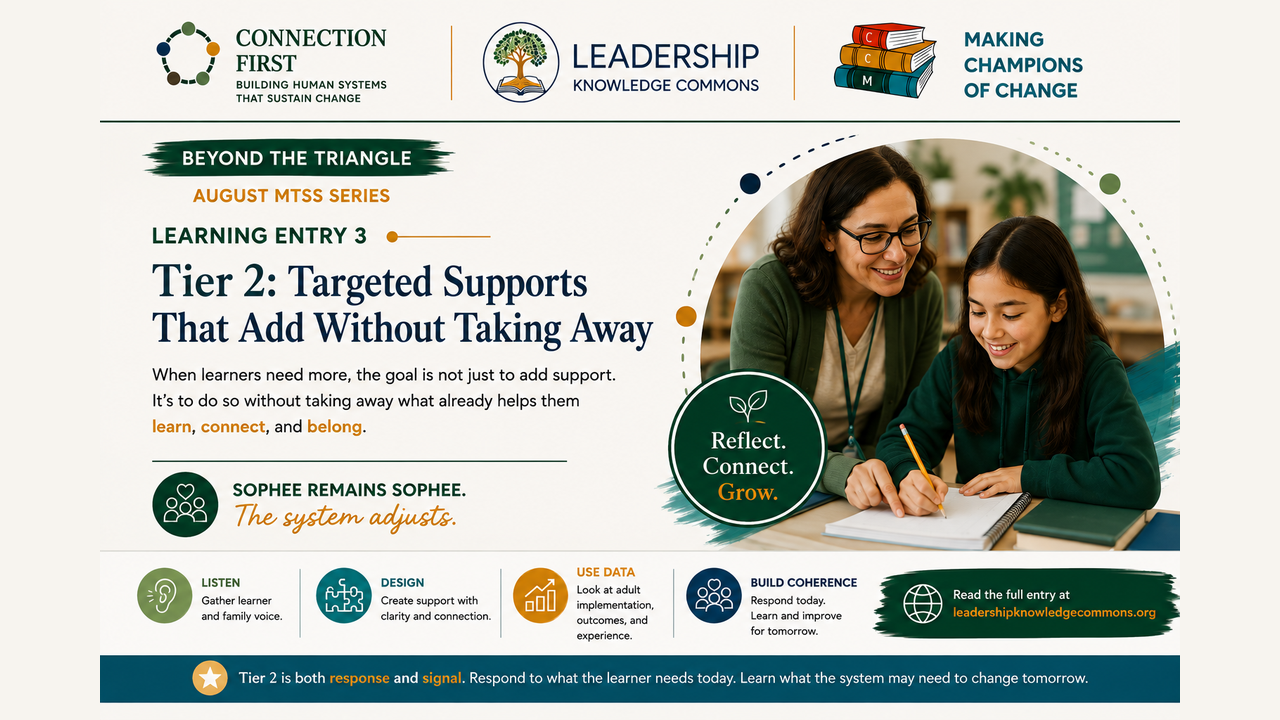
Tier 2: Targeted Supports That Add Without Taking Away
August Learning Series: Beyond the Triangle - Entry 3
By: Janine Gacke, Ed.S. and Megan Garbe, Ed.S.
Estimated read time: ~7-8 minutes
Support Should Add, Not Remove
Sophee knows exactly how advisory works. She knows who will say her name at the door, which routine comes first, and that if she walks in quieter than usual, someone will notice before she has to explain why. None of that is dramatic. It's just steady — the kind of day predictable enough that she can actually show up inside of it.
Now, Sophee needs more. The team agrees that additional support could help with organization, task initiation, and asking for help. A six-week small group is available during advisory. On paper, the solution works.
But Sophee likes advisory. It is where her friends are, where a trusted teacher notices when something's off, and where she catches up after an absence. She feels comfortable asking the questions that did not feel safe to ask during class.
The principal looks at the schedule again. There is no obvious alternative. Moving the interventionist means moving another group. Pulling Sophee from a core class creates a different problem. Asking the classroom teacher to add the intervention independently ignores what that teacher is already carrying.
Sophee needs more. The adults have limits. Both things are true. So when a learner needs more, where does the system find the “more”?
This is one of the least visible leadership tensions inside Tier 2. Additional support requires time, people, attention, and space. Those resources have to come from somewhere. Unless leaders make those tradeoffs visible, the learner may quietly absorb the cost.
Sophee gets the intervention, but she may lose advisory. That is the design problem.
The Center on PBIS describes Tier 2 as targeted support that builds upon the universal foundation rather than replacing it (Center on PBIS, n.d.). Protecting that principle inside a real schedule is harder than stating it.
Support should add what a learner needs without unnecessarily taking away what already helps that learner learn, connect, and belong.
When Added Support Becomes a Place
Tier 2 is often described through the intervention itself: a small group, check-in/check-out, additional practice, or more frequent feedback. But the form of a support does not determine how it will be experienced.
A small group can feel like connection or removal. A daily check-in can feel encouraging or like one more place where a learner is being watched. Extra practice can build confidence or repeatedly pull a student away from a part of the day where they already feel successful.
The conditions surrounding the support matter more than the support itself: whether Sophee understands why it's being added and stays connected to her regular instruction and relationships, whether the adults involved actually know what she's practicing, and whether her family understands the purpose well enough to know if it's working.
Tier 2 isn't a place Sophee gets sent to. It's a response the system adds around her, while she stays exactly where she already belongs. That's the shift Center on PBIS guidance points toward: support that stays tied to the universal system, driven by real data, and structured enough to actually help (Center on PBIS, n.d.).
Now imagine Sophee leaves advisory with little explanation. A friend asks where she is going. Sophee shrugs. Someone says she was “referred for Tier 2.” She does not know what that means.
At the end of the week, she asks:
How long do I have to do this?
The answer is:
We’ll see.
No one intended to create uncertainty. But Sophee has been left to make meaning from incomplete information.
Screening and progress-monitoring data can tell us that a pattern exists. They cannot fully tell us what Sophee is experiencing, what already works for her, or what her family sees that the school may not yet see. That requires another kind of information: listening. Safir and Dugan (2021) encourage educators to bring learner strengths, voice, and qualitative information alongside more conventional forms of school data. Before deciding what to add, teams need to consider information with the learner and family, not only about them.
Leadership Lens — Designing Support That Stays Connected
Once the team understands more about Sophee's experience, the leadership work shifts from identifying a need to designing the conditions around the response. The question becomes: what needs to be true around this support for it to work as part of Sophee's larger experience?
That begins with clarity. Instead of telling Sophee she is “receiving Tier 2,” adults can explain what they've noticed, what support is being added, how long they plan to try it, and when everyone will review what's happening. Now the support has a purpose and a review point. Sophee is part of the learning process.
Leadership also means protecting connection. Every targeted support uses something finite: staff time, instructional minutes, scheduling flexibility, space, or student attention. Sometimes a tradeoff is necessary. But it should be visible.
Advisory may still be the best time for Sophee’s group. The difference is that the team no longer treats advisory as empty space on a schedule - they recognize the friendships, trusted adult, and connection Sophee already experiences there.
The question changes from where can we fit this intervention, to: if we add support here, what are we taking away—and how will we protect what matters?
Maybe Sophee attends only certain days. Perhaps the schedule rotates, or some of the practice moves into the classroom. There may not be a perfect solution. Responsive leadership does not eliminate every constraint. It makes the consequences visible enough for teams to choose intentionally.
The adults surrounding the intervention matter, too. Research on check-in/check-out illustrates the importance of recurring adult contact and organized implementation procedures around targeted support (Hawken et al., 2007). That means someone coordinating the support, teachers who know what she's practicing, a way for her family to share what they notice, and a defined point for the team to decide whether it continues, changes, or fades.
Otherwise, Sophee becomes the person carrying the connections between adults.
The learner should not have to hold together a support system the adults have designed.
System Coherence Lens — Before We Ask How the Student Responded
Three weeks later, Sophee's team meets again. The obvious question is whether the intervention is working. But a coherent system asks another question — sometimes before a learner ever enters targeted support: what were students actually experiencing before we decided who needed more?
If universal practice includes explicitly teaching routines, providing predictable pathways for help, or checking for understanding, teams need to know whether those practices were consistently available. That means examining adult implementation alongside student outcomes — not to blame or evaluate individual educators, but to understand the conditions the system has created.
Suppose Sophee is struggling while most classmates are successfully navigating a consistently implemented routine. A targeted response may be appropriate. But what if seven students in the same classroom are struggling with multistep assignments? What if the routine is dependable in some settings and inconsistent in others?
The leadership question becomes: is this an individual pattern requiring targeted support — or a shared pattern calling for a classwide or universal response? Sometimes the answer is both. Sophee may need support now while the classroom strengthens a practice that could benefit several learners. The goal is not to delay help until Tier 1 is perfect. It is to respond to Sophee while remaining curious about what her experience may be teaching us about the system.
A coherent team brings three sources of information together:
Adult implementation: What did we provide?
Student outcomes: What pattern are we seeing?
Student and family experience: What is happening from their perspective?
No single source tells the whole story. Research examining targeted supports similarly demonstrates the value of considering implementation and participant perceptions alongside student outcomes (Oakes et al., 2012).
Tier 2 is both response and signal. It responds to what Sophee needs today while helping the system learn what may need to change tomorrow.
Reflect. Connect. Grow.
Reflect.
- When I hear that a learner needs targeted support, what assumptions do I notice about what that support should look like?
- Where do I quietly absorb a tradeoff myself — solving a scheduling or resource problem without naming out loud what it's costing someone
Connect.
- What patterns repeat across students, classrooms, teams, or settings?
- Where might targeted support be compensating for something that could be strengthened within universal or classwide practice?
Grow.
- What's one thing I could make clearer — purpose, timeline, or next step — the next time I introduce added support to a student?
- What's one small way I could make sure a support I'm already offering adds to a student's day instead of quietly costing them something?
Looking Forward — Bringing the System Closer
Sophee needed more support.
The system found a way to provide it.
But the deeper question was whether the system could add what Sophee needed without quietly asking her to give up something else that mattered.
Students need more. Time is finite. Adults have limits. The goal is not a system without constraints. It is a system that notices who is carrying the cost of those constraints—and learns from what it sees.
Sometimes even a well-designed targeted support is not specific enough. A learner may need greater intensity, deeper coordination, or more individualized adaptation.
That brings us to the next layer.
Individualization should bring the system closer to the learner—not leave the learner navigating the system alone.
References
Center on PBIS. (n.d.). Tier 2. Positive Behavioral Interventions & Supports, University of Oregon.
Hawken, L. S., MacLeod, K. S., & Rawlings, L. (2007). Effects of the Behavior Education Program on office discipline referrals of elementary school students. Journal of Positive Behavior Interventions, 9(2), 94–101.
Oakes, W. P., Lane, K. L., Cox, M., Magrane, A., Jenkins, A., & Hankins, K. (2012). Tier 2 supports to improve motivation and performance of elementary students with behavioral challenges and poor work completion. Education and Treatment of Children, 35(4), 547–584.
Safir, S., & Dugan, J. (2021). Street data: A next-generation model for equity, pedagogy, and school transformation. Corwin.
