August 2026 Learning Series: Beyond the Triangle (Entry 4 - Tier 3: Individualized Supports That Bring the System Closer Together)
Aug 27, 2026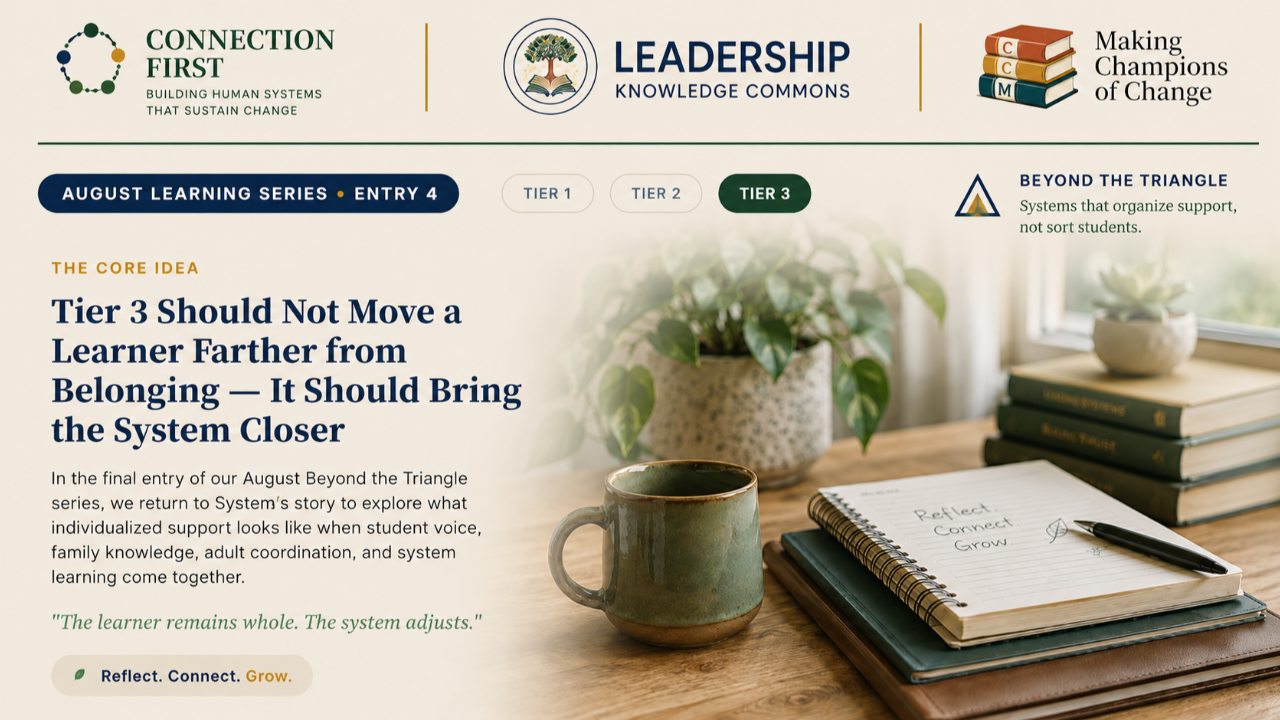
Tier 3: Individualized Supports That Bring the System Closer Together
August Learning Series: Beyond the Triangle - Entry 4
By: Janine Gacke, Ed.S. and Megan Garbe, Ed.S.
Estimated read time: ~8 minutes
Individualization Is Not Isolation
In the previous entry, Sophee needed more. Her team added targeted support for organization, task initiation, and asking for help. Some things improved. A shared visual helped her begin multistep assignments. Brief check-ins helped when schedules changed. But the support did not address everything.
Some weeks, Sophee still became overwhelmed. Strategies that worked in a small group did not always carry into every classroom. Her grandmother noticed something the school’s data had not shown: Sophee had stopped asking certain teachers for help because she believed her questions irritated them.
That detail did not erase the team’s data. It changed what the data meant.
As the team considered more individualized support, the question shifted from “What else should Sophee do?” to “What do we need to understand and design differently around her?”
Tier 3 should not be the point at which the system becomes most clinical.
It should be the point at which the system becomes most attentive.
When the Process Becomes the Main Character
Individualized support carries real responsibility. There may be assessments, timelines, services, progress monitoring, and decisions with significant consequences. Those processes matter. The problem begins when the process becomes the main character—when a meeting spends more time describing a learner than listening to them, or when a family is asked to approve a plan they had little role in shaping.
Sophee’s incomplete assignments can be documented accurately and still not explain why the pattern changes by classroom, relationship, or week. Educators know instruction. Specialists bring assessment and intervention expertise. Families know history and patterns across settings. Sophee knows what it feels like to move through all of it.
Individualization becomes more accurate when those ways of knowing meet. Family-school partnership is strongest when families help shape the educational response rather than simply receive information about it (Reschly & Christenson, 2012).
For Sophee, meaningful participation might begin with a trusted adult asking:
What is going well that we should protect?
What makes asking for help harder?
What would tell you this plan is helping?
Student voice does not require a learner to perform vulnerability in a room full of adults. It requires meaningful influence. If Sophee says she avoids asking certain adults for help, the team should not automatically give her another help-seeking strategy. It should also examine relational safety.
The question becomes:
What can we design differently, together?
Leadership & Design Lens — Specificity With, Not For
Tier 3 is sometimes equated with doing more: more minutes, more check-ins, more data, more supervision. But individualization is not accumulation. Data-based individualization emphasizes using learner information, progress monitoring, and intentional adaptation to make support more precise rather than simply adding more intervention (National Center on Intensive Intervention, n.d.).
For Sophee, that might mean one consistent visual pathway instead of multiple reminder systems, coordinating deadlines across teachers, or protecting advisory relationships while changing when added support occurs. A useful individualized plan identifies more than what Sophee will do differently. It also clarifies what adults will do differently, which universal and targeted supports remain available, how Sophee and her family will participate, and when the team will review the plan.
Individualization is not something adults do to a learner.
It is something people build with the learner.
Several weeks later, Sophee says the visual routine helps, especially when teachers use similar language. The small group has helped her break large assignments into steps. But repeatedly missing advisory still costs her relationships she values. Then teachers notice something larger: several students struggle when assignments involve changing deadlines, multiple platforms, or coordination across classes.
The team lets the information move.
Teachers begin using a shared visual structure for multistep assignments as part of universal practice. The targeted group adjusts its schedule so students do not repeatedly lose the same valued experience. Sophee keeps a brief planning check-in while the team considers which supports should continue, change, or fade.
The system is learning.
System Coherence Lens — Where the Layers Come Together
MTSS is often represented as support moving upward in intensity. But the triangle cannot show a family observation changing how a team interprets data, a targeted strategy improving universal practice, or a leader changing a schedule because added support is costing students belonging.
Those movements are where coherence becomes visible.
Tier 1 provides the predictable, accessible, and relational foundation students experience every day. Tier 2 adds focused instruction, feedback, practice, or connection when universal support alone is not enough. Tier 3 adds greater specificity, coordination, adaptation, and partnership when a more standardized response is insufficient.
The layers become a system when information, responsibility, and learning move between them.
Sophee’s individualized support helped the team recognize a broader challenge with multistep assignments. That learning moved into universal practice. Her targeted support provided a place to practice strategies. Tier 1 relationships gave her trusted places to say when something was not working.
Each layer strengthened the others. A school can contain many supports and still feel fragmented. Coherence is not the number of supports a system offers. It is the degree to which those supports make sense together. Fullan and Quinn (2016) describe coherence as a shared understanding of the work and how its parts connect across a system.
Tier 3 cannot become the place where a fragmented system sends its most complex work.
The complexity belongs to the system.
So does the responsibility for coherence.
Reflect. Connect. Grow.
Reflect: When a student needs more support, which question do I reach for first - what should they do differently, or what haven’t we understood yet?
Connect: Where does information move between universal, targeted, and individualized support in your system—and where does it stop?
Grow: What is one change that would help me design support with learners and families and allow what I learn to strengthen the larger system?
Looking Forward — Beyond the Triangle
Across this series, we have moved beyond the triangle.
We began by returning tiers to their intended place. They are not identities assigned to learners. They describe what a system provides.
We explored Tier 1 as the routines, relationships, clarity, access, and predictability that create the conditions in which support can work. We followed Sophee into Tier 2 and asked what happens when a learner needs more without losing belonging.
At Tier 3, greater individualization should not mean greater separation. It should bring the system closer—to the learner’s experience, family knowledge, the conditions shaping the pattern, and shared responsibility.
Sophee did not become Tier 2. She did not become Tier 3.
Sophee remained Sophee.
What changed was the system’s understanding of what she needed and its ability to respond. That may be the most important shift in moving beyond the triangle. MTSS is not about moving students efficiently through tiers. It is about building a system capable of responding to human variability while protecting learning, dignity, access, and belonging.
The work remains unfinished because people, needs, relationships, and contexts continue to change. That is not evidence that coherence has failed. It is why coherence must continue to be held. The triangle may help us see levels of support. But the relationships between those levels are what make MTSS a system.
The learner remains whole. The system adjusts.
And when the system learns from the people moving through it, every layer can become stronger.
References
Fullan, M., & Quinn, J. (2016). Coherence: The right drivers in action for schools, districts, and systems. Corwin.
National Center on Intensive Intervention. (n.d.). Data-based individualization: Intensive intervention. American Institutes for Research.
Reschly, A. L., & Christenson, S. L. (2012). Moving from “context matters” to engaged partnerships with families. Journal of Educational and Psychological Consultation, 22(1–2), 62–78.
