
August 2026 Learning Series: Beyond the Triangle (Entry 1: What Multi-Tiered Systems of Supports Actually Mean)
Aug 06, 2026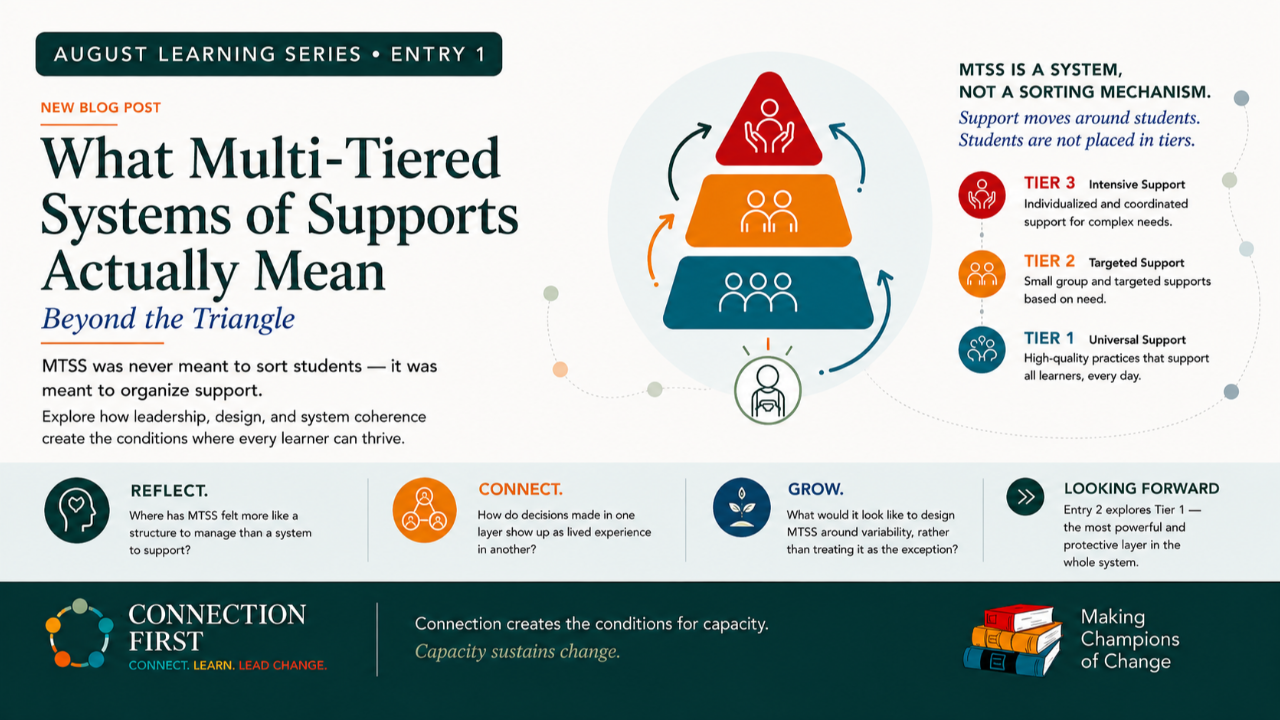
What Multi-Tiered Systems of Supports Actually Mean
August Learning Series: Beyond the Triangle - Entry 1
by: Janine Gacke, Ed.S. and Megan Garbe
Estimated read time: ~9 minutes
When the Triangle Becomes the Work
If you've spent any time in MTSS work, you know the shape by heart. Three tiers, stacked wide to narrow, colored in shades of urgency. It shows up on every slide deck, every wall poster, every training handout — and somewhere along the way, that image stopped illustrating the work and started replacing it.
This isn't a failure of understanding. The triangle did exactly what a good visual is supposed to do: it made a complex system legible, fast. The trouble is what happens next. Legibility hardens into habit, and habit quietly becomes a destination. Tiers stop being a way of talking about support and start being read as where a student belongs — a place, not a response.
This is one way implementation drift can occur. Implementation drift happens when the version of a framework enacted in practice gradually moves away from its intended purpose or critical features (Carroll et al., 2007). Drift is rarely a single decision. It tends to accumulate through small, reasonable adjustments — a faster way to route a referral, a simpler way to describe a meeting outcome — until the framework that emerges no longer resembles the one that was designed. In this case, a framework built to organize increasingly responsive support can drift into a mechanism for organizing students.
MTSS was never meant to sort students — it was meant to organize support.
That single sentence is the hinge this entry turns on. Everything that follows, in this piece and across the series, is really just taking it seriously.
Lived Experience — How MTSS Is Commonly Felt
Ask a teacher what MTSS feels like day to day, and the triangle rarely comes up. What comes up instead is a referral form that takes longer to complete than the intervention itself. A meeting where the decision was more or less made before anyone sat down. A student who moved to “Tier 2” and nobody quite explained why — including, often, to the student and their family.
This is what it feels like when a system is procedural, when decisions feel distant from the people they affect, and when support arrives reactively instead of by design. None of it comes from bad intent. It comes from a gap between how MTSS was designed to work and how it is actually lived by the people inside it — teachers filling out the forms, students moving through the layers, families trying to make sense of language that was never explained to them in the first place.
Implementation research consistently shows that outcomes are influenced not only by the selected practice but also by how it is delivered and by the organizational conditions surrounding it (Carroll et al., 2007; Durlak & DuPre, 2008). A well-designed intervention, delivered inside a poorly designed process, still produces the lived experience described above. The practice was never the problem — which is exactly why more training on the practice so rarely fixes it.
The issue is not misunderstanding — it's misalignment between design and experience.
That distinction matters more than it sounds like it should, because it changes where you look for the fix. Misunderstanding gets solved with better explanation. Misalignment gets solved by redesigning the thing itself. It's worth sitting with, honestly, before reading further: where have I seen MTSS reduce complexity instead of hold it?
Leadership & Design Lens — MTSS as Systems Architecture
Reframed with care, MTSS is not a sorting mechanism. It is a way to design predictability with flexibility built in — a system that expects variability rather than treating it as an exception to be managed. The tiers are not containers students get placed into. They are the structure that adapts around people, not the other way around.
That reframe has to show up in language, not just intention, or it doesn't really happen. Layers. Levels of support. Responsiveness. Those words carry movement inside them. “Placement” and “tier assignment” don't — they describe a location, not a relationship. Leaders shape how tiers get talked about long before they shape how tiers actually get used, and the words tend to arrive first. This is design work, not messaging work — it changes what a tier means the next time a student moves through one.
Implementation research reinforces this point: even strong practices are difficult to sustain when training, coaching, data systems, leadership structures, organizational supports, and decision pathways are fragmented (Fixsen et al., 2005). Language is one piece of that architecture. It is not a substitute for the rest of it, but it is rarely separate from it either — the words a system uses tend to reveal, and eventually reinforce, whichever structure actually sits underneath them. A leader who changes the vocabulary without touching the coaching model, the data routines, or the decision pathway has changed the surface, not the architecture, and the system will eventually say so.
System Coherence — Why Layers Must Work Together
A multi-tiered system cannot become coherent when each layer operates as its own program, with its own team, its own meeting, and its own data set, running in parallel with the others. None of this holds if the layers stay separate.
Universal practices touch every other part of the system, whether or not anyone intended them to. When expectations, instruction, relationships, and routines are inconsistent, more learners end up needing additional support — not because their needs intensified, but because their daily experience of school was fragmented. A strong Tier 1 protects Tiers 2 and 3 by reducing how much intensified support is ever needed in the first place.
At the same time, what happens at Tier 2 is not only a response — it is information about Tier 1. When several students need the same additional instruction or behavioral skill, that pattern is usually asking the system to look back at the clarity and consistency of universal practice. It's rarely just about the students who surfaced it. Targeted support isn't evidence that universal practice failed — it's feedback that should route back into Tier 1, not a file.
The same logic holds at Tier 3, just more intensely: the most individualized layer is also the one most dependent on the system that surrounds it — strong universal practice, coordinated support, family partnership, and steady leadership. However specialized the support looks on paper, it cannot function in isolation — and treating it as if it can is often where the most hidden labor in a building quietly accumulates.
Early schoolwide support frameworks described prevention and intervention as a continuum in which universal practices remain available to all learners while more targeted or individualized practices are added according to need (Horner et al., 2010; Sugai & Horner, 2002, 2006). Read this way, universal practices create the conditions in which additional supports can work. Targeted supports offer timely responsiveness and surface emerging patterns. Individualized supports add greater specificity, coordination, and partnership. None of the three replaces the others. A continuum assumes movement in both directions and shared ownership across layers; a stack of isolated tiers assumes neither, and a system built on the wrong assumption will keep producing the very rigidity it was designed to prevent.
Ecological theory reminds us that development occurs within interconnected environments rather than inside an individual alone (Bronfenbrenner, 1979). Systems thinking similarly cautions leaders against isolating a visible outcome from the structures, relationships, and feedback patterns producing it (Meadows, 2008). A student's movement through MTSS is one such outcome. Read on its own, it looks like a fact about the student. Read inside the system producing it, it becomes a fact about the conditions surrounding them — which is a very different, and far more useful, thing for a leader to notice, because only one of those two readings points toward something a system can actually change.
This is the thread the next three entries in this series pick up, one layer at a time.
Reflect. Connect. Grow.
Reflect. Where has MTSS felt more like a structure to manage than a system to support?
Connect. How do decisions made in one layer show up as lived experience in another?
Grow. What would it look like to design MTSS around variability, rather than treating variability as the exception?
Looking Forward
Entry 2 goes to the layer most people think they already understand: Tier 1. Not as a baseline, and not as “what everyone does anyway” — but as the most powerful, most protective layer in the whole system, and the foundation everything else quietly depends on.
References
Bronfenbrenner, U. (1979). The ecology of human development: Experiments by nature and design. Harvard University Press.
Carroll, C., Patterson, M., Wood, S., Booth, A., Rick, J., & Balain, S. (2007). A conceptual framework for implementation fidelity. Implementation Science, 2, Article 40.
Durlak, J. A., & DuPre, E. P. (2008). Implementation matters: A review of research on the influence of implementation on program outcomes and the factors affecting implementation. American Journal of Community Psychology, 41(3–4), 327–350.
Fixsen, D. L., Naoom, S. F., Blase, K. A., Friedman, R. M., & Wallace, F. (2005). Implementation research: A synthesis of the literature. University of South Florida, Louis de la Parte Florida Mental Health Institute, National Implementation Research Network.
Goering, M. A. (2026). Reflect. Connect. Grow.: Adult learning design framework. Leadership Knowledge Commons, Making Champions of Change.
Horner, R. H., Sugai, G., & Anderson, C. M. (2010). Examining the evidence base for school-wide positive behavior support. Focus on Exceptional Children, 42(8), 1–14.
Meadows, D. H. (2008). Thinking in systems: A primer. Chelsea Green Publishing.
Sugai, G., & Horner, R. H. (2002). The evolution of discipline practices: School-wide positive behavior supports. Child & Family Behavior Therapy, 24(1–2), 23–50.
Sugai, G., & Horner, R. H. (2006). A promising approach for expanding and sustaining school-wide positive behavior support. School Psychology Review, 35(2), 245–259.
