
Learning With Adults: Dignity, Agency, and the Work of Becoming (Learning Entry 1: Why Adults Learn Differently)
Apr 01, 2026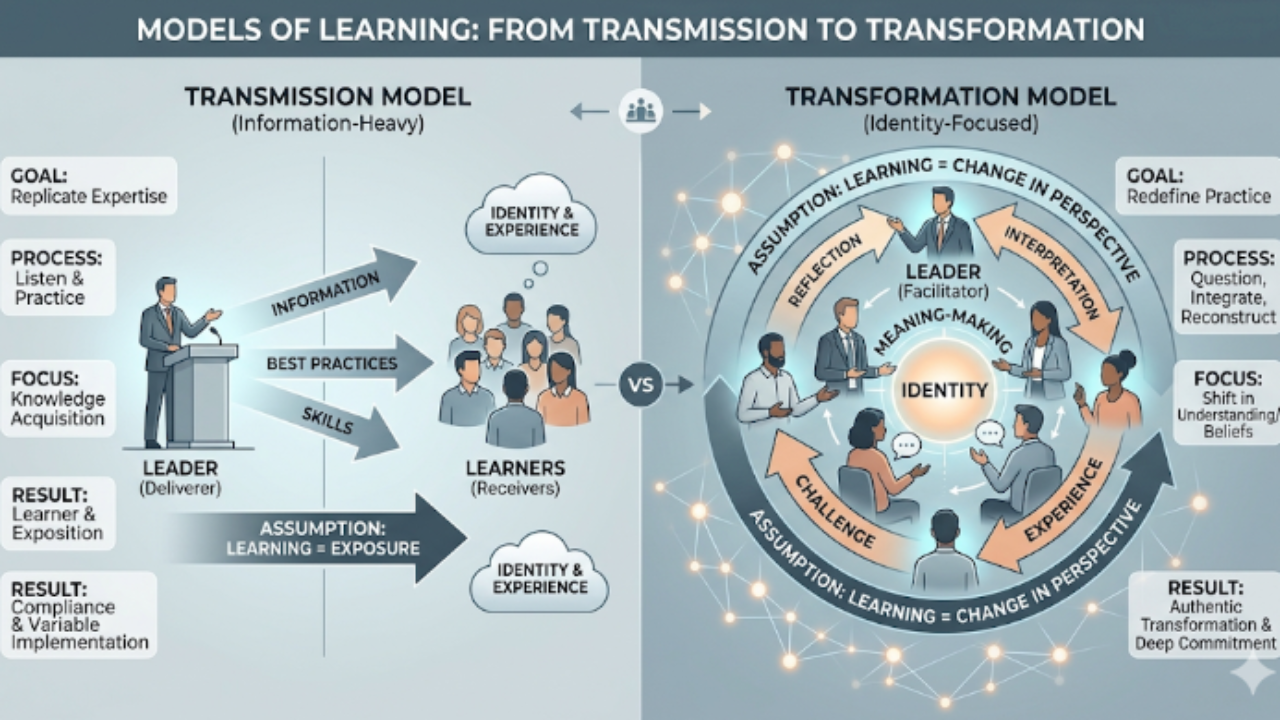
Why Adults Learn Differently: What Leaders Must Understand
By Dr. Amy Pahl and Dr. Morgan Goering
April Series: Learning With Adults: Dignity, Agency, and the Work of Becoming
Estimated read time: ~8.5 minutes
Learning as Transformation, Not Transmission
Many leaders have spent years designing, facilitating, and participating in professional learning without ever being formally introduced to the field of adult learning itself. The prevailing assumption, often unspoken, is that learning is largely a matter of exposure: if we present clear information, provide strong examples, and create space for practice, improvement will follow. Yet, across systems, a different pattern continues to emerge. Learning does not consistently translate into changed practice. We often mistake a lack of change for a lack of skill when engagement fluctuates, or momentum builds and then softens. In some cases, participation remains high while transformation remains limited. These patterns are often attributed to competing priorities, gaps in skill, or variability in implementation. While each of those explanations holds some truth, they do not fully account for what leaders are experiencing. When professional development stalls, it is rarely because the information is unclear, rather it is because we’ve ignored the psychological identity work required to adopt the learning. To lead change, we must move away from giving information to shifting identity.
Adult learning theory, Andragogy, offers a more comprehensive view of the needs of the people implementing the learning. Jack Mezirow’s theory of transformative learning suggests that adult learning is not primarily about acquiring new knowledge. Rather, it is about how individuals interpret, question, and, at times, reconstruct the assumptions that shape their understanding of their work and themselves (Mezirow, 1997). Learning, in this sense, is not additive; it is interpretive and even disruptive at times.
This distinction matters because it reframes what leaders are actually asking adults to do. When new practices are introduced, adults are not simply learning something new. They are being asked, often implicitly, to examine existing beliefs, revisit prior experiences, and consider whether their current ways of working still align with emerging expectations. This process can surface uncertainty, tension, and hesitation, not as resistance to the work, but as a natural part of learning itself. In practice, these shifts are easily misinterpreted. On the surface, the room remains full, and participation appears steady; people take notes, nod, and contribute to the discussion. While the external conditions for learning seem intact, the internal landscape begins to shift. Questions become more cautious, and risk-taking narrows as contributions drift from authentic thinking to adhering to perceived expectations. Learning has not stopped; it has changed from transformative to compliance.
What looks like disengagement in these moments is actually protective sense-making. As adults navigate the tension between new ideas and their established professional identity, they are constantly assessing the psychological safety of the room. When leaders fail to recognize this internal negotiation, they often react with increased urgency or tighter facilitation—well-intentioned moves that unintentionally reinforce the very conditions that stifle deeper learning. If learning is, as Mezirow suggests, a process of meaning-making and transformation, then leadership must attend not only to what is being taught, but to how that learning is being experienced.
Adult Learning Reality: Identity Is Always in the Room
Adults do not enter learning environments as neutral participants. They bring with them a history of experiences that shape how new ideas are interpreted, accepted, or challenged. These experiences include not only prior learning, but also moments where their competence was affirmed, questioned, or misunderstood. Over time, these experiences form a lens through which all new learning is filtered, which is why adult learning is inseparable from identity.
When adults engage in professional learning, they are not simply asking whether something works. They are also asking what it means for their practice, their role, and their sense of effectiveness. When learning affirms identity, engagement deepens. Conversely, when learning threatens identity, particularly without support or clarity in next steps, engagement often becomes cautious, compliant, or performative. This is not resistance in the traditional sense. It is an interpretation, adults making meaning, in real time.
- Will I be able to implement this practice in reality?
- Do I have all these skills?
- Will there be time for safe practice and feedback?
- What happens if this doesn’t match the structure of my classroom and potential barriers are a concern?
Research in adult learning and motivation shows adults are more likely to engage deeply in learning when they experience autonomy, relevance, and a sense of competence (Deci & Ryan, 2000; Knowles, 1984). When those conditions are absent, disengagement is not a failure of the individual. It is a signal from the system. More information about listening to this type of data arising in your system can be found in the Data as a Mirror Series. Offering opportunities for teams and individuals to see and hear themselves in the work, to surface potential successes and challenges together alongside their identities, can build meaning-making into any learning opportunity.
Leadership & Coaching Practice: Leading Learning as an Invitation, Not a Directive
If adult learning is shaped by meaning-making and identity, then leadership must shift from delivering information to designing conditions that support interpretation. While this shift is often subtle, it is highly significant to transformative learning. Effective leaders shift their focus from the content to the conditions, scrutinizing how learning is introduced and how they personally 'hold' the group’s uncertainty. Rather than forcing a quick resolution to ease tension, space for deep reflection is prioritized. Most importantly, silence is reframed: it is no longer misread as disengagement, but recognized as an invitation to examine whether the current environment feels safe enough for authentic sharing.
In practice, this may look like:
- Framing new learning as exploration rather than expectation
- Acknowledging complexity rather than simplifying prematurely
- Responding to uncertainty with curiosity rather than correction
- Creating structured opportunities for reflection before discussion
These moves create the very environment that allows authentic rigor to take root. When adults experience learning as an invitation rather than a directive, they are more likely to engage authentically, take risks, and remain present through the discomfort that meaningful learning often requires.
System & Design Lens: Learning Is a Design Responsibility
While individual leadership moves, like responding with curiosity, are essential, they cannot overcome design issues. Although learning is experienced individually, it is shaped systemically. Professional learning structures communicate powerful messages about what is valued. When learning is tightly paced, heavily scripted, or closely tied to evaluation, adults may interpret it as compliance-oriented, regardless of the stated intent. When learning allows for reflection, connection, and gradual development, adults are more likely to experience it as supportive and meaningful. Cognitive load theory further reminds us that adults have a finite capacity for processing new information (Sweller, 1988). When systems introduce multiple initiatives without sufficient time for integration, even highly motivated professionals may struggle to engage deeply. This cannot be shifted by effort, only by design. Leaders who view adult learning as a design responsibility consider not only what is being asked, but when, how, and under what conditions. Clarity, pacing, and psychological safety are recognized as foundational features of learning.
Reflect. Connect. Grow. A Structure for Adult Meaning-Making
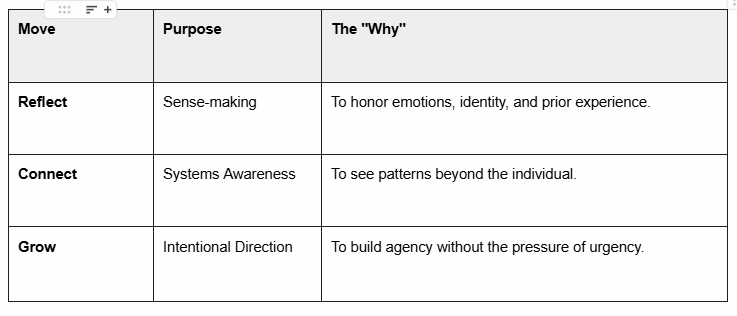
To move from protective sense-making to authentic engagement, leaders need a repeatable structure. The Reflect. Connect. Grow. Adult Learning Design Framework is designed to lower the identity threat by normalizing the messy process of interpretation. If adult learning is a process of meaning-making, then leaders need consistent structures that support that process without turning reflection into another task.
Reflect. Connect. Grow. is a simple, repeatable framework designed to help adults move from exposure to understanding to intentional action. It can be used in any learning context: team meetings, professional development sessions, coaching conversations, or informal reflection. At its core, the framework aligns with how adults learn:
- Reflect: supports sense-making and by grounding new ideas in emotions, experience, and identity
- Connect: surfaces patterns across roles, teams, and systems, moving from individual tension to collective
- Grow: identifies intentional, manageable next steps that honors learner agency
 Importantly, the framework is not designed to produce immediate action. It is designed to slow thinking down just enough for meaning to form.
Designing Questions Within the Framework
Leaders can generate questions for any learning experience by anchoring to three moves:
Reflect (Sense-Making & Identity)
- What is this bringing up in yourself or in your current practice?
- Where does this align, or not, with your experience?
- What feels clear, and what feels uncertain right now?
Connect (Systems Awareness & Patterns)
- Where are you seeing this show up across teams or roles?
- What patterns are emerging, not just isolated examples?
- Are there clear leverage points to be celebrated? Barrier concerns to be named?
Grow (Intentional Direction)
- What is one small shift that could strengthen this work?
- Where could clarity reduce strain?
- What would it look like to move forward with intention rather than urgency?
Why This Matters
If we leave reflection to chance, we leave learning to chance. Without a deliberate structure, professional dialogue often stays on the surface: safe, polite, and ultimately transactional. Reflect. Connect. Grow. matters because it changes the "rules" of the room:
- It protects dignity: By grounding the work in reflection, we honor the expertise and history adults bring to the table.
- It surfaces systemic truth: By prioritizing connection, we move past isolated anecdotes and begin to see the patterns that either support or constrain our work.
- It builds sustainable agency: By focusing on "Grow" rather than "Act," we replace the exhaustion of constant urgency with the power of intentional direction.
The framework provides just enough structure to support adult learning without constraining it. This creates a consistent pathway for leaders to treat learning not as a one-time event to be managed, but as an ongoing process of transformation.
Reflect. Connect. Grow.
Reflect (Sense-Making & Identity)
- When have you experienced learning as affirming, and when has it felt performative or compliance-driven?
Connect (Systems Awareness & Patterns)
- How do current professional learning structures in your system support, or constrain, authentic engagement?
Grow (Intentional Direction)
- What is one shift you could make to create more space for meaning-making in your next learning experience?
Looking Forward
If adults learn through meaning-making, identity, and interpretation, then the role of leadership extends beyond designing learning experiences to shaping how those experiences are held. Leadership is not the delivery of a curriculum; it is the stewardship of a transformation. By attending to the identity work beneath the skill work, we turn 'resistance' into the very fuel for change. This becomes especially visible in coaching as well.
In many systems, coaching remains closely tied to correction, even when framed as support. As a result, risk narrows and engagement becomes cautious at the very moment learning requires expansion. In the next learning entry, we will explore how coaching can shift from correction to partnership, and how that shift changes not only how adults learn, but whether they choose to engage at all.
References
Deci, E. L., & Ryan, R. M. (2000). The “what” and “why” of goal pursuits: Human needs and the self-determination of behavior. Psychological Inquiry, 11(4), 227–268.
Edmondson, A. C. (2019). The fearless organization: Creating psychological safety in the workplace for learning, innovation, and growth. Wiley.
Knowles, M. S. (1984). The adult learner: A neglected species (3rd ed.). Gulf Publishing.
Mezirow, J. (1997). Transformative learning: Theory to practice. New Directions for Adult and Continuing Education, 1997(74), 5–12.
Sweller, J. (1988). Cognitive load during problem solving: Effects on learning. Cognitive Science, 12(2), 257–285.
