
The Science of Doing: Implementation to Excellence (Learning Entry 2: Coaching for Consistency)
Mar 12, 2026
Coaching for Consistency: Supporting Leaders and Educators Through the Implementation Dip
By Janine Gacke
March Series: The Science of Doing: Implementation to Excellence
Estimated read time: ~7.5 minutes
Implementation is not what we intend; it is what people experience.
Grounding Wonder: How do leaders and teams align implementation actions with current reality without losing people, purpose, or progress along the way?
The Dip Is a System Signal
Early implementation rarely unfolds as smoothly as systems initially expect. As new practices move from professional learning sessions into classrooms and team routines, uncertainty begins to surface. Variability becomes more visible, questions multiply, and the initial momentum surrounding the work often softens. In many systems, this moment can feel like a loss of progress. In practice, it is usually a signal that implementation has reached the stage where learning becomes visible.
Implementation science often describes this period as the implementation dip, the space where teams move from conceptual understanding toward applied practice. It is during this stage that educators begin translating shared ideas into real classroom decisions. That translation is rarely seamless. Questions about priorities, flexibility, and expectations surface in ways that professional learning sessions alone cannot anticipate.
In my work supporting MTSS systems and behavior support teams, I have seen how this moment carries a particular emotional weight for educators. The work still matters deeply to the adults responsible for it, yet the clarity that existed during planning meetings begins to blur when practices enter the complexity of real classrooms. It is not uncommon for educators to quietly question whether their interpretation of the practice aligns with system expectations.
Psychological safety research reminds us that learning under conditions of uncertainty requires environments where individuals feel supported in asking questions and refining their practice (Edmondson, 2019). When early implementation challenges are interpreted primarily through evaluation or compliance, variability often deepens and momentum slows. When those same challenges are met with coaching, however, systems gain an opportunity to stabilize learning and strengthen alignment. Seen through this lens, the implementation dip is not failure. It is feedback about how well the system is supporting the work.
Implementation in Practice
In many schools and districts, leadership teams invest considerable energy in selecting initiatives that align with student needs. I have sat in many of those meetings. Teams gather around conference tables with thoughtful intentions, discussing research, examining data, and building consensus around the practices most likely to support students. Roles are assigned, timelines are created, and the work moves forward with a sense of shared purpose.
Yet once the meeting ends, each team member returns to the daily rhythm of their professional responsibilities. Instructional planning continues. Student needs arise unexpectedly. Communication with families and colleagues fills the day. Within this cadence of responsibilities, implementation work must compete for attention with the many other commitments educators carry. The next meeting often feels familiar. As the team reconvenes, updates begin to surface. One person acknowledges that progress on a task was slower than expected. Another shares that urgent student needs redirected their time. Someone else explains that they attempted part of the work but remain uncertain about how it should look in practice.
The people around the table still care deeply about the initiative. The challenge is not belief. Instead, the difficulty emerges from the gap between shared intention and the system structures needed to sustain progress across classrooms and buildings. During this stage, educators frequently hold quiet questions that are not always voiced directly:
- Am I doing this right?
- How much flexibility is allowed?
- What should I actually prioritize?
These questions rarely signal a lack of commitment. More often, they reflect the natural process of calibrating practice within a complex system.
Leadership & Coaching Practice
This is where coaching becomes essential. In my experience, effective coaching shows up in the moment when uncertainty surfaces, not to correct, but to clarify. Coaching conversations often become a form of translation between system intention and classroom practice. Together, we name the questions that matter:
- What elements of the practice are essential to maintain its integrity?
- Where is thoughtful adaptation appropriate?
- What supports are available as educators continue learning?
When these conversations happen consistently, uncertainty becomes shared learning rather than private frustration. The message communicated to educators is simple but powerful: you are not expected to navigate this work alone. Research on professional learning reinforces this experience. New practices are significantly more likely to transfer into classroom use when coaching is embedded in ongoing practice and when feedback occurs in the context of real work rather than isolated training sessions (Joyce & Showers, 2002). Coaching, in this sense, is not an add‑on to implementation. It is part of the infrastructure that allows learning to stabilize.
We recognize that the depth of coaching and adult learning (Andragogy) cannot be covered in a single section or set of sections across other learning series. Therefore, the Making Champions of Change Team has decided to build an Adult Learning Series in April to further dive into this topic.
System & Structure Lens
Although coaching conversations often occur at the level of individual classrooms or teams, their effectiveness depends heavily on the clarity of the broader system. When expectations for practice remain ambiguous, coaching risks becoming inconsistent or overly subjective across settings. Implementation science offers several tools designed to strengthen shared understanding of practice. Practice Profiles, sometimes referred to as Implementation Practice Profiles, provide structured descriptions of what a practice looks like when implemented as intended. These profiles outline the essential components of a practice while also identifying common variations that may emerge during early implementation (Fixsen et al., 2013).
Closely related tools such as Innovation Configuration (IC) Maps visually represent how a practice may appear across different levels of implementation. When used as learning tools rather than evaluation instruments, IC Maps help teams develop a shared language for interpreting practice across classrooms and roles (Metz & Bartley, 2012). Example Innovation Configuration (IC) Map:
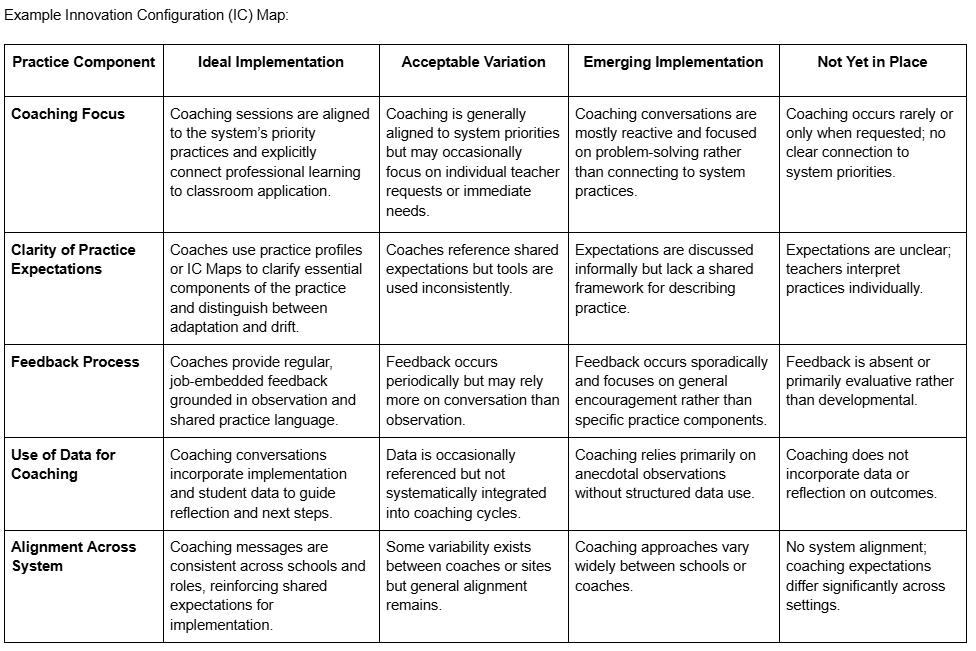
Coaching Reflection Questions Using the IC Map
When a coach and educator review practice together, they might ask:
- Which column best reflects what we observed today?
- What component of the practice is most developed right now?
- Which element could we strengthen next?
- What support would make that step easier?
Together, these tools help systems answer several questions that frequently surface during early implementation:
- What does this practice look like when implemented with integrity?
- Which adaptations reflect thoughtful contextualization, and which signal drift from the intended practice?
- What misunderstandings commonly emerge as teams begin applying the practice in real settings?
By clarifying these distinctions, systems reduce the cognitive and emotional load placed on educators who are attempting to interpret new expectations while maintaining their daily responsibilities. Clarity reduces friction. Shared clarity reduces burnout. When coaching conversations, professional learning structures, and implementation expectations align, coherence begins to emerge across people and settings. Within such systems, coaching is experienced not as evaluation but as a professional partnership.
Reflect. Connect. Grow.
Reflect (individual sense-making)
Where might variability in practice be signaling unclear expectations rather than a lack of effort?
Connect (system patterning)
How aligned are coaching messages across the different roles and settings within your system?
Grow (intentional direction without urgency)
What step toward greater clarity might reduce friction for educators attempting to implement this work?
Looking Forward
Coaching provides essential support for individuals navigating the complexity of early implementation. Yet sustaining change across a system ultimately requires structures that extend beyond individual coaching relationships. The next learning entry explores how MTSS teams function as the infrastructure that carries implementation forward, enabling systems to notice patterns, remove barriers, and sustain progress in ways that individual educators cannot accomplish alone.
This week’s Leadership Knowledge Commons learning entry is written by guest author Janine Gacke. Her work spans MTSS, Tier 3 behavior systems, Specially Designed Instruction (SDI), and statewide scaling of evidence-based practices. She has led teams through the complexity of interpreting behavior and implementation data in moments that carry high stakes for students and adults alike. Check out her leader and learner profile!
References
Edmondson, A. C. (2019). The fearless organization: Creating psychological safety in the workplace for learning, innovation, and growth. Wiley.
Fixsen, D. L., Blase, K., Metz, A., & Van Dyke, M. (2013). Statewide implementation of evidence‑based programs. National Implementation Research Network.
Joyce, B., & Showers, B. (2002). Student achievement through staff development (3rd ed.). ASCD.
Metz, A., & Bartley, L. (2012). Active implementation frameworks for program success. Zero to Three Journal, 32(4), 11–18.
