
June 2026 Series: The Human Side of Teacher Retention (Entry 1: The Hidden Cost of Teacher Turnover)
Jun 04, 2026
June Learning Series: The Human Side of Teacher Retention
Entry 1: The Hidden Cost of Teacher Turnover
Estimated read time: ~5-8 minutes
The Cycle Nobody Budgets For
Every spring, education leaders enter a familiar, rhythmic season of hiring: post the position, screen the candidates, host interviews, and hope the new hires stick. It’s an exhausting annual cycle, but it’s one we accept as inevitable. After all, people move, retire, and change careers—hiring is just part of the job, right?
It is entirely normal to view turnover as a seasonal pattern we just have to endure. But treating exits as unavoidable creates a costly blind spot. When we accept turnover as "just the way it is," we overlook the hidden, staggering costs—both to our budgets and our school culture.
What if a chaotic hiring season isn't actually inevitable? And what if the secret to balancing your budget isn't finding places to cut, but protecting the investments you’ve already made?
BELIEFS IN PRACTICE
What We Believe — and What It Costs Us
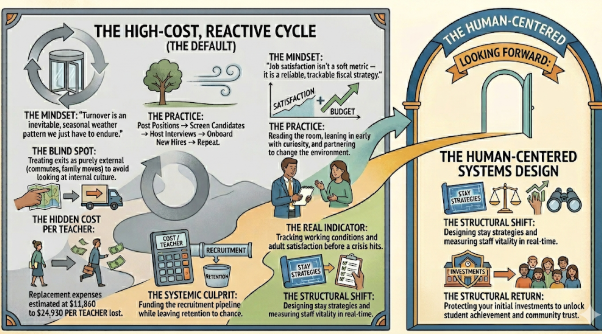
When we treat turnover as an unchangeable law of nature, our leadership behavior becomes purely reactive. We fall into a predictable pattern: post, hire, onboard, repeat. Because we assume the exit was bound to happen anyway, we rarely calculate the actual cost of this cycle, letting it quietly drain our budgets year after year.
The actual impact is staggering. The Learning Policy Institute’s analysis shows that replacing a single teacher costs between $11,860 and $24,930, depending on district size (Learning Policy Institute, 2024). For a smaller district losing 10 teachers, that is an invisible $118,600 penalty; in a larger district, it tops $249,000. In an era of painful budget cuts, we are actively funding a revolving door before we even account for the devastating ripple effects on student achievement and remaining staff morale.
This "inevitable turnover" mindset doesn't just drain our funds; it alters how we interact with our team. When a teacher shows signs of dissatisfaction or mentions leaving, the internal belief can default to “Well, people leave.” Believing this lets us off the hook, driving us to avoid the root causes of their unhappiness and attribute exits to external forces like a shorter commute or a family move.
But the data tells a different story about why teachers walk out the door. Research consistently shows that departure is driven by job satisfaction and working conditions far more than retirement or compensation. This reality becomes a call to action in light of recent data from a College Board study showing that only 39% of high school teachers report high job satisfaction, while 20% expressed leaving intentions (Ewing et al., 2024).
When we look at these numbers through a leadership lens, an unexpected opportunity emerges. Job satisfaction isn't a nice to have, it is a fiscal strategy. Cost savings aren't hiding in line-item cuts; they are sitting right in front of us, waiting to be realized by changing how we support the people we already have.
LEADERSHIP PRACTICE
Seeing the Signal Before it Becomes a Vacancy
The leaders most effective at retention are not the ones with the best hiring process. They are the ones who rarely need it — because they learned to read the room before they lost people.
Reading the room is a specific practice. It means noticing that the teacher who used to linger after meetings has stopped. That the one who used to push back now goes quiet. That someone is technically present in every required space and genuinely absent from everything optional. These signals surface long before a resignation letter does. The leader who catches them early has simply decided that watching the adult culture is as important as managing the operational calendar.
What leaders do with those signals matters as much as noticing them. The timing is delicate — a check-in that comes too early can feel like surveillance, one that comes too late can feel like a formality. The window is a genuine, low-stakes moment of curiosity before the situation becomes a conversation about leaving. Not a formal calendar event. A question in the hallway that genuinely asks "How are you doing?”
The hardest discipline is restraint — staying in the discomfort long enough to actually understand what is being said, rather than immediately solving, reassigning, or reframing. When leaders move too quickly to fix, they communicate without meaning to that honesty has a cost.
The four REEL domains give leaders a framework for making sense of what they are seeing: psychological safety to restore energy, genuine connection with colleagues, real agency over meaningful decisions, and space for learning that feels alive. When any of these is absent, the signals appear. The framework does not tell leaders what to do. It tells them where to look.
SYSTEM & STRUCTURE LENS
The System That Normalizes Leaving
Teacher attrition is not primarily a people problem. It is a systems problem — one that school and district structures have inadvertently reinforced for decades. That distinction matters, because it changes the question from what is wrong with this leader to what is this system actually built to do?
Look at where the budget goes. District structures routinely allocate extensive resources to the recruitment pipeline — job boards, hiring fairs, onboarding software, substitute coverage during interviews. Those same structures rarely feature a dedicated line item for retention. There is no annual budget for belonging. There is no structural mechanism for measuring job satisfaction before the crisis hits. The system is not designed to catch the signal early. It is designed to replace what it loses.
That design produces a predictable loop. When a resignation lands, the operational response is to redistribute responsibilities to the remaining high-performers — which increases their load, accelerates their depletion, and makes the next departure more likely. Top-down professional development, superficial teacher input, and accumulating demands without structural relief are not failures of individual leadership. They are the outputs of a system that was never designed with retention as a priority. The system is not broken. It is working exactly as it was built — and what it was built to do is normalize leaving.
The REEL framework — Restore, Engage, Empower, Learn — was developed in response to that structural reality. It is not a program to implement or a compliance checklist to complete. It is a diagnostic lens for examining whether a school environment is systematically structured to support the full human beings who work there — not just the professionals, but the people. Each subsequent entry in this series takes one REEL domain and asks: what would it look like if this were a leadership priority, not an afterthought?
Reflect. Connect. Grow.
Reflect. (Sense-Making and Mindset)
- When a high-performing teacher tells you they are leaving, what is your immediate internal narrative? Do you default to external reasons or do you pause to consider the internal conditions of your building?
- In what ways have you inadvertently treated teacher turnover as an inevitable seasonal weather pattern rather than a metric you can actively influence?
Connect. (Relational Dynamics and Cultural Signals)
- If you stepped out of the operational hum tomorrow to map the adult culture, what would you notice?
- Think of a time you noticed a teacher operating in a permanent state of "empty." What was your tone and timing in response? Did you lean in with curiosity early, or did you wait for a formal milestone to check in?
Grow. (Systemic Design and Action)
- Look at your current data systems and budget priorities. Are you structurally over-investing in the recruitment pipeline while leaving the retention strategy to chance?
- What is one structural barrier in your school's daily schedule or layout that actively prevents teachers from having the space and grace to restore their energy?
LOOKING FORWARD
What Comes Next
The belief that retention is a seasonal staffing problem — something to manage each spring and absorb each fall — is one of the most expensive beliefs a school system can hold. Not primarily because of the dollar figure, though that figure is real and significant. Because of what the belief prevents leaders from seeing: that the conditions driving teachers out the door are conditions leaders have the power to change.
Retention is not a hiring problem. It is a design problem — and design problems have design solutions within reach of any leader willing to examine what their system is actually built to do. The next entry begins where the research points: with Restore. The belief underneath that domain is simple and significant: restoration is an organizational responsibility. What would change in your building if you lived out that belief?
References
Ewing, M., Fletcher, K., Howell, J., Jacklin, A., & Ovcjak, L. (2024, July). Job satisfaction and retention among high school teachers in the United States: Evidence from the 2023–24 school year (Research Brief). College Board.
Learning Policy Institute. (2024, September 17). 2024 update: What's the cost of teacher turnover? [Interactive tool].
Pahl, A. L. (2022). Addressing teacher attrition through trauma-informed practices in the workplace (Publication No. 714) [Doctoral dissertation, Minnesota State University Moorhead]. RED: Repository for Educational Documentation.
