
Learning With Adults: Dignity, Agency, and the Work of Becoming (Learning Entry 5: Gratitude as a Leadership Skill)
Apr 30, 2026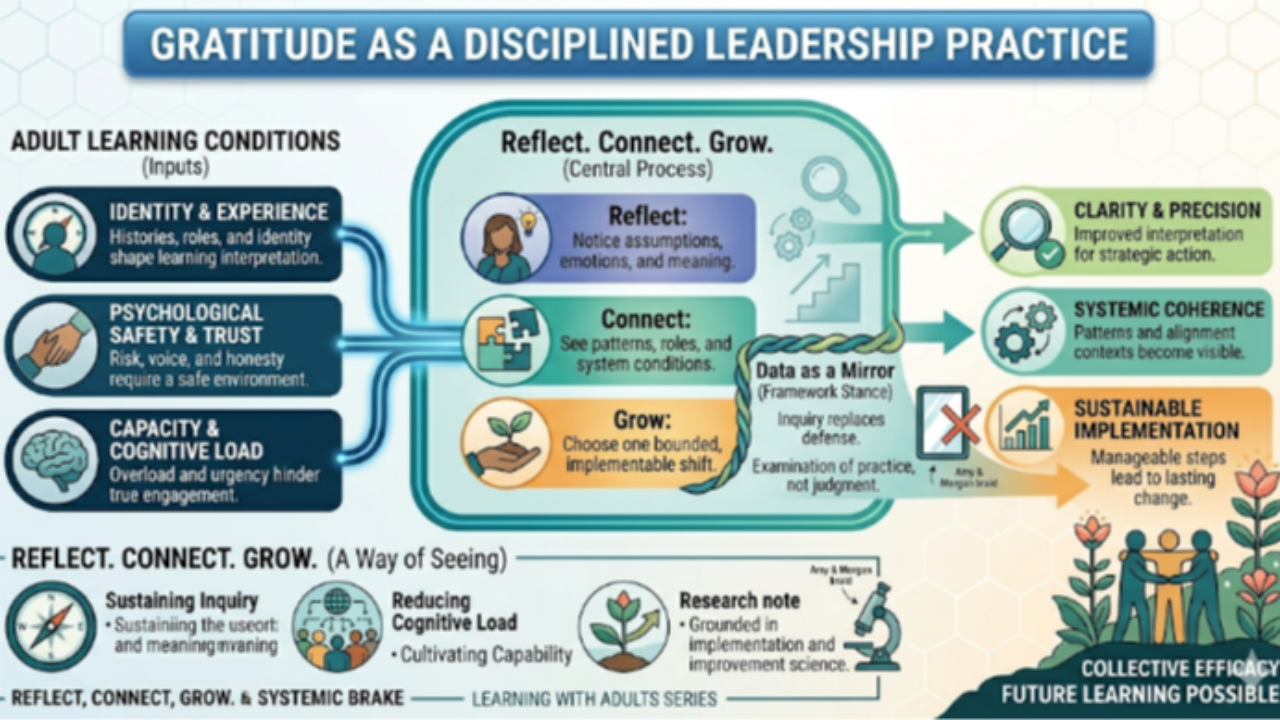
Gratitude as a Leadership Skill: Sustaining adult learning through noticing, trust, and relational steadiness
By Dr. Amy Pahl and Dr. Morgan Goering
Check out their Leader and Learner Profiles by clicking on their names!
April Series: Learning With Adults: Dignity, Agency, and the Work of Becoming
Estimated read time: ~6.5 minutes
What is gratitude doing in a series on adult learning?
In the high-pressure environment of educational leadership, gratitude is often relegated to the periphery. It is frequently seen as a "soft" landing after the harder conversations we’ve navigated regarding identity, coaching, capacity, and assessment. When our vision of gratitude is limited to a seasonal email, a staff meeting shout-out, or a polite gesture to conclude a busy week, it remains a decorative feature—well-intentioned, but ultimately disconnected from the actual struggle and complexity of the work.
In that sense, gratitude is not separate from leadership; it is one of the ways leadership learns to see. Gratitude is not exhausted by celebration or applause. It is something far more rigorous. In "Showing Up with Gratitude," Morgan framed it as a deeper act of listening—one that honors not just the visible win, but it's also the quiet courage it takes for an educator to name what is unresolved. This stance was deepened in "Hidden Stories Beneath the Surface," where gratitude was braided with grace and curiosity to resist the cynical tendency to misread a teacher’s protection as defiance. Finally, through "The Last Burst of Color" and "A Season of Gratitude and Renewal," Dr. Goering situated this practice within the uneven rhythms of change, recognizing that growth isn't always a vibrant display; more often, it is a slow, invisible season of renewal that requires a leader's patient witness.
Taken together, these insights suggest that in your leadership vocabulary, gratitude should never be sentimental. It is an interpretive stance. It is the discipline that keeps a leader from reducing a person to their performance at the very moment the system is most likely to do so. This final entry extends that stance by anchoring it in the reality of adult learning—asking what gratitude makes possible not only for the heart but also for pedagogy and the organization as a whole.
Adult Learning Reality: Gratitude protects the conditions that enable adults to keep learning.
Across this series, one argument has remained steady: adults do not learn as disembodied recipients of information. They learn as people whose histories, identities, and experiences shape how every new demand is interpreted. Knowles’ (1980) account of adult learning remains essential here because it refuses the fiction that adults are blank slates; instead, it recognizes that they bring a deep need for relevance and self-direction into every space. When systems ignore these realities, adults do not resist learning itself; they resist irrelevance, coercion, and the experience of being acted upon rather than engaged.
Self-Determination Theory (Deci & Ryan, 2000) sharpens this point by identifying autonomy, competence, and relatedness as basic psychological needs. When these needs are supported, engagement deepens; when they are frustrated, motivation becomes brittle and externally regulated. Gratitude matters because it strengthens these conditions in subtle, cumulative ways. It affirms competence without converting it into performance theater and reinforces relatedness by making individual contributions visible to the collective. In this context, data becomes a mirror when inquiry replaces defense, allowing adult practice to be examined alongside student outcomes without threatening psychological safety. By recognizing genuine agency rather than merely rewarding compliance, gratitude ceases to be an accessory to adult learning; it becomes the very ecology that protects it.
This becomes especially clear when considered alongside psychological safety. Edmondson (2019) makes plain that learning behaviors—asking for help, admitting uncertainty, or seeking feedback—all involve significant interpersonal risk. Perceived threat reduces our cognitive and behavioral flexibility at the very moment greater openness is required. Assessment without trust narrows learning. Leaders must ask what helps trust endure through difficult feedback, uneven implementation, or persistent strain. Gratitude—understood as disciplined noticing rather than generic praise—contributes to that durability and building of trust. It signals that people are more than the deficits under discussion. It reminds adults that their effort, judgment, care, and relational labor are seen, even when outcomes remain mixed.
That recognition does not make hard conversations unnecessary; it makes them more survivable. Gratitude, when practiced deeply, is a bridge. It connects the personal with the collective, the celebratory with the challenging, the individual voice with the system’s purpose. Leaders who show up with gratitude don’t stand above the work; they stand with their teams, in partnership.
Leadership and Coaching Practice: Gratitude as noticing, not praise
One of the risks in writing about gratitude for educational leaders is that the concept collapses too quickly into praise, morale-boosting language, or broad encouragement. That drift would weaken the argument. Praise tends to move vertically; it is often bestowed by someone in authority or upon someone whose actions are being affirmed. Gratitude, by contrast, works relationally and precisely. It notices what has been carried, what has been attempted, and what has been risked—naming the contributions that make outcomes possible.
This rigorous approach begins before a leader even enters the room, as we see in the Data As A Mirror framework. It requires asking: What signals will I send about curiosity vs. judgment? and What emotional response from this team might be rational?. By grounding preparation in these questions, gratitude becomes less about making people "feel good" and more about calibrating attention toward what the system must not overlook.
This is where Amy’s and Morgan’s lenses braid naturally with the Data as a Mirror Double Loop Conversation Framework (Click to See!). Amy’s coaching perspective makes visible the immense effort adults carry that never reaches formal recognition because it is relational rather than spectacular: the work of rebuilding confidence after a setback or remaining open in a conversation that would have been easier to shut down. Morgan’s systems lens, by contrast, notices how institutions often consume this invisible labor while rewarding only visible performance.
To bridge this gap, the system must intentionally build in pauses to hold up a mirror—moving beyond a "single-loop" focus on student patterns to a "double-loop" examination of the adults in the room. This reflective space allows a team to interrogate not only visible adult practices, but the underlying assumptions, beliefs, and system conditions that shape what is possible. When we hold the mirror in this way, gratitude becomes a tool for collective sense-making, ensuring that meaning-making always precedes movement.
Together, these perspectives push gratitude beyond niceness and into discernment. They ask the essential leadership questions:
- What in this system is essential but easily missed?
- Who is holding the emotional and interpretive work of change?
- What forms of steadiness allow learning to continue even when the bright markers of progress are not yet obvious?
Jane Dutton’s (2003) work on high-quality connections is especially useful here because it grounds relational life in organizations as consequential rather than ornamental. High-quality connections—marked by mutual regard, trust, and active engagement—help people feel more competent and alive at work. Gratitude strengthens these connections because it functions as relational information. It communicates that value has been recognized and attributed to another’s intentional action.
For leaders, the implications are direct. Gratitude, practiced as a discipline, builds the relational infrastructure that makes future learning possible—especially in systems where fatigue or evaluative pressure would otherwise constrict engagement.
System and Design Lens: Gratitude, collective efficacy, and sustainability
At the system level, gratitude matters because it shapes what a community comes to notice about itself. Schools are interpretive environments; what leaders consistently name becomes the definition of the work. If we notice only urgency, gaps, and deficiencies, our systems become deficit-attuned. But if we intentionally notice effort, mutual support, and the invisible labor of implementation, our systems begin to see themselves as capable of carrying difficulty without being defined by it.
This is where gratitude intersects with Collective Efficacy. Research consistently shows that a faculty’s shared belief in its capability is a primary driver of student learning (Goddard, Hoy, & Woolfolk Hoy, 2004). That belief is not built by optimism alone; it is built when adults see that their work with one another has substance, traction, and consequence. Gratitude contributes to this perception by making the collective contribution visible. It reminds the system that progress is not only found in the outcome, but in the relational and instructional capacities built along the way.
A system-aligned leader, then, uses gratitude to audit the environment itself, asking if their current routines protect inquiry or simply rush closure. They recognize that certain system conditions—the clarity of authority, the use of time, and the strength of trust—must be intentionally reinforced before any improvement becomes sustainable. In this light, gratitude is the tool that makes those foundational conditions visible so they can be strengthened.
This distinction is critical during seasons of strain, where the absence of immediate results often tempts leaders toward two extremes: performative positivity or relentless correction. Neither response sustains adult learning. The first feels hollow; the second becomes corrosive. Gratitude offers a narrower, more disciplined alternative. It does not deny difficulty, nor does it substitute appreciation for accountability. Instead, it names what is still worthy of effort within the difficulty. It notices:
- The colleague who stayed.
- The team that kept meeting.
- The educator who revised their statement rather than retreating.
- The school that held onto its values while outcomes were still emerging.
Gratitude helps a system continue investing in learning by making visible the evidence that the work is still alive—even when its fruits are uneven or delayed.
Reflect. Connect. Grow.
Reflect: Sense-Making & Lived Experience with Interpretation
The goal is to surface the "internal monologue" of your leadership and notice the invisible labor sustaining the system.
- The Unseen Labor: What am I becoming accustomed to that no longer receives my attention? Where am I overlooking forms of labor that are relational or emotional rather than measurable?
- Assumptions of Value: What assumptions am I holding about what counts as a meaningful contribution? Where do I notice people continuing to show up despite ambiguity or a lack of clarity?
- The Gap: Where do I feel tension between what is being asked of people and what is being acknowledged? Where might I be interpreting outcomes without attending to the experience that produced them?
Connect: Systems Awareness & Patterns, Variations, Structure
The goal is to see gratitude not as a feeling, but as a "signal" that moves through the organization.
- Signals of Value: How does our system signal what is valued—through language, time, or attention? Where are we reinforcing performance over growth in how we acknowledge work?
- Visibility Patterns: Where is contribution consistently visible, and where does it remain largely unseen? How does the experience of gratitude differ across roles, identities, or levels of the system?
- Trust and Withdrawal: What patterns exist between moments of recognition and moments of withdrawal or disengagement? Where do people appear to carry disproportionate relational labor?
Grow: Intentional Direction & Small, System-Aligned Shifts
The goal is to identify one bounded, system-aligned move that strengthens the ecology of learning.
- Calibrating Attention: What is one specific contribution I can name that would strengthen clarity about what is valued? How might I adjust how and when I notice so it becomes consistent, rather than episodic?
- Embedding Gratitude: What is one existing routine or structure where gratitude could be embedded without adding complexity? How can I model "noticing" in a way that others can replicate?
- Sustaining the Work: Where could naming effort (not just outcomes) strengthen trust over time? What is one way to align recognition with the specific kind of learning we are trying to sustain?
Looking Forward: A Final Word on Leading with Gratitude
If this series began with the argument that adult learning is identity work before it is skill work, it closes by naming the practice that keeps adults willing to learn in that deeper sense. Gratitude, understood rigorously, is not a soft conclusion appended to "harder" work. It is the harder work.
It is the practice that sustains the relational conditions in which adults can continue to reflect, risk, revise, and remain in community. It helps leaders resist the narrowing tendencies of urgency, evaluation, and deficit-attuned attention. Most importantly, it protects the human texture of systems that might otherwise mistake efficiency for depth.
Educational change is not carried only by strategy, structure, or expertise. It is carried by people whose effort is far more substantial than what formal measures can capture. To lead with gratitude, then, is not merely to be appreciative. It is to notice well enough—and steadily enough—that learning can continue.
A Final Reflection: The Leader as Witness
Throughout these five entries, we have traveled from the internal monologues of the learner to the structural design of the system. We have moved from the vulnerability of coaching to the discipline of systemic gratitude.
As you close this entry and return to your daily work, consider:
- What is the "Hidden Story" in your system right now that is waiting for a leader to notice?
- How might your next conversation shift if you viewed it as an act of partnership rather than correction?
- In a system that often demands more, where will you find the discipline to choose coherence over accumulation?
The tool we have explored—Reflect. Connect. Grow.—is not just for meetings. This is a way of seeing. Rather, it is a commitment to the idea that in our schools, the learner is as important as the learning.
References
Deci, E. L., & Ryan, R. M. (2000). The “what” and “why” of goal pursuits: Human needs and the self-determination of behavior. Psychological Inquiry, 11(4), 227–268.
Edmondson, A. C. (1999). Psychological safety and learning behavior in work teams. Administrative Science Quarterly, 44(2), 350–383.
Knowles, M. S. (andragogy overview reflected in adult-learning summaries emphasizing self-direction, experience, and readiness).
Stephens, J. P., Heaphy, E., & Dutton, J. E. High-quality connections research summary.
Fehr, R., Fulmer, A., Awtrey, E., & Miller, J. (2017). The grateful workplace: A multilevel model of gratitude in organizations. Academy of Management Review, 42(2), 361–381.
Goddard, R. D., Hoy, W. K., & Hoy, A. W. collective efficacy research in schools.
Di Fabio, A. et al. Gratitude in organizations review.
